Saturday, January 17, 2026
Discipline over Doom-scrolling?
Sunday, February 2, 2025
Bluesky account, SUPdate, and new GPS watch
Well, gee. It has been a while since I've made a blog post. Blogs are so "old internet" now. Gears are churning in my mind, though, and I'm thinking that maybe old internet has some advantages over the extremely algorithm-driven, addictive, doom-scrolling-for-profit, orchestrated-and-manipulated-by-oligarchs-aligned-with-fascists disaster that is "new internet."
Towards that end I've created an account on supposedly-less-worse-than-facebook-and-twitter/X social media platform "bluesky" - https://bsky.app/profile/jamesgdouglass.bsky.social
Bluesky doesn't allow posts more than 300 words, but that could kind of work out if I put long rants and picture-filled posts here on my blog, and just link to them on bluesky. Unlike facebook, I think bluesky doesn't deprioritize posts linking to outside websites.
As for personal news, I've been working a lot trying to keep up with my teaching and research responsibilities at FGCU and I haven't been able to do as much watersports as I would like. I am still paddleboarding at least once a week, though, and I've changed paddleboards. Unlike the pre-hurricane-Ian days when I lived in a house with a shed and could store lots of toys, I am now limited to what I can store permanently in my 2009 Chrysler Town & Country mini-van, and one 14' SUP board that I store on top of the kitchen cabinets with a little rack system that probably voids the security deposit on the one-bedroom apartment I live in with Rhonda.
The 14' SUP I originally had on top of the cabinets was a 23" wide Riviera RP raceboard from 2017. It was really beat up and many-times repaired from injuries sustained even prior to 2022's Hurricane Ian. Anyway, I finally decided to give it away after getting frustrated with how much trouble I had staying on it in the rough water 2024 Key West Classic race. After all, I still had a slower but more seaworthy 14'x27.25" Fanatic Falcon 2014 raceboard collecting dust in my buddy Serge's backyard shipping container storage unit. So the Riviera went away and I'm now exclusively using the big red Fanatic, which is also windsurfable, by the way, because of the mast track I installed in it a long time ago.
My favorite paddle route is circumnavigating Lover's Key. It's an annoyingly long, trafficky drive from where I live now to Lover's Key, but I know I can always get a dirt parking spot there, and it's free. There's a closer place where I can get in the water (the Estero River), but flat water paddling is comparatively boring, and paddling the wide Fanatic in flat water is kind of sad because it's significantly slower than the narrow Riviera was. If I'm in bumpy water or waves I don't notice that.
Friday, December 30, 2022
Thoughts on SWFL economy and moving from house to an apartment
One of the indirect consequences of Hurricane Ian was that it motivated my landlord to sell the house in Bonita Springs that my spouse Rhonda and I had been renting and living in since 2012.
Initial rent for the house was reasonable, and it went up just 16% from 2012-2022, which was less than the 29.7% cumulative rate of inflation in the US from 2012-2022 (https://www.usinflationcalculator.com). So we were actually getting a little better deal on rent in 2022 than in 2012. Of course that assumes that university faculty salaries in Florida kept up with inflation over that time period, which they didn't quite do, but since I got promoted from assistant professor to associate professor in 2018 we were alright.
Unfortunately, the less-than-inflation rate of rent increase that we experienced from 2012-2022 was extremely atypical for the area. Every other place in SW Florida was experiencing insanely high rent inflation, like 300% from 2012-2022. I.e., a small house like ours could rent for $2850 (or more) now. This was probably another part of our landlord's motivation to sell.
The first wave of sticker shock hit me when we started searching for a new place and realized the single family homes for rent were all some combination of: A) way too expensive, B) way too far away, and C) not available. So I was like, "Dang, I guess we have to switch down to an apartment." The second wave of sticker shock was realizing that even the single bedroom apartments in our area were a lot more expensive per month than the house had been. So I was like, "Holy moly, I have to pay way more per month AND give up the longboard windsurf and paddleboards that I built my outdoor recreation, exercise, and social routine around for 10 years? YUCK!" The sacrifices Rhonda would be making would be of similar order, including giving up space for visiting family, arts and crafts supplies, writer's library, home office space, etc.
One ray of hope and consolation was the prospect of moving closer to work and reducing my commute to bike-able distance. That was a tough thing, though, since near the FGCU campus you have to pay at least as much for a 1 bedroom apartment as you would pay for a 2 bedroom apartment with a 30 minute commute. There were some fraught negotiation surrounding the size vs. distance tradeoff, amid the stressful labor and expense of filling out endless electronic forms for multiple apartment applications. In the end the smaller but closer apartment won out, and we signed the lease.
Moving was accomplished with a rented Penske truck between the 12th and 15th of December, and the two dogs and two humans that comprise our family unit have now been fully transplanted to the apartment, at "Longitude81" behind Hertz Arena, where the Everblades play hockey. The watersports gear I didn't sell is convalescing at friends' houses- the 14' Riviera paddleboard in my old neighborhood, and the 14' Fanatic paddleboard and 11'8 Exocet Windsup in a colleague's backyard storage unit. I've so far made one trip back to the old neighborhood to paddle the Riviera, and one trip to Bunche Beach in Fort Myers to windsurf with the shortboard that now lives permanently in my minivan. So it looks like I will preserve my watersports hobbies in some form, but to get enough exercise I'm also going to have to jog and use the little gym room at the apartment complex.
One thing that's on my list to do is figure out exactly what watersports I can do at the lake on the FGCU campus, and when I can do them without getting hassled by the campus cops. Around two years ago I was getting a pretty good routine going of hydrofoil windsurfing on the FGCU lake, but then a campus police officer told me I could only do it when the lifeguards were on station at the lakefront, which I think rules out the after-work sessions I was getting. BEGIN BEACH ACCESS RANT: Beach and lake access in SW Florida was getting really difficult even before the storm. We've got miles of near-empty private beaches for rich people to look at from their mansions or condos, but not nearly enough public beach parking to accommodate inland residents and tourists. The post-hurricane closures of almost all the beaches in Lee County and North Collier County, combined with pathogenic bacteria, red tide fish kills, etc. has made the beach access situation even worse, of course. My partial solution would be to condemn the destroyed beachfront lots and let them be public parking areas but that would be anethema to the pro-privitization ethos of area leaders.
Ok, how do I wrap this up? I'm moving forward with all the optimism I can muster, but struggling with the demoralizing effects of current circumstances. I'm getting more politically charged against the rich-take-all, screw-the-environment, damn-the-poor economic trend that seems to have taken hold of the world, and particularly this peninsular state, as its effects are becoming more and more invasive in my life and the lives of my colleagues, friends, and neighbors. That anger is tempered somewhat by reminding myself that living more simply and eliminating my car commute is a good thing for the planet that I probably should have done anyway, and I still have the really important essentials like safe shelter and a beloved partner to share it with.
Saturday, September 26, 2020
Sloppy stars surfski kayaking practice in the ocean
To improve my rough water balance and comfort level for the October 3rd Key West Classic race, I've been deliberately paddling in the ocean at odd angles to the wind and waves. (It's not THAT hard to go straight upwind or straight downwind, perpendicular the bumps, but getting the waves from the side and at oblique angles is quite tricky.) I've sometimes done a workout like this as "sloppy squares," drawing boxes with my path, but I changed it up this week with what I'm calling "sloppy stars." I program the workout in my Speedcoach GPS as 10x800m with no rest between the segments, and then I just have to estimate what angle to go at and remember to always turn left at the end of each segment to make the star pattern. I'm pleased with how this turned out.
Sunday, November 12, 2017
SUP Race Report: Englewood Beach Paddlefest 2017

Race: Englewood Beach Paddlefest 2017
Date it happened: 11 November 2017.
Host/Sponsors: Hosted by "Hooked on SUP Paddlesports" and a bunch of other sponsors and volunteers listed on the race's paddleguru page.
Location: The Gulf of Mexico off Englewood Beach, Florida, and into Stump Pass inlet.
Distance: There were three race courses- a 9.2 km one, a 4.8 km one, and a 2.4 km one. The long one went south along the beach and briefly into Stump Pass inlet, before coming back out and going north along to the beach to the start / finish. (See my GPS track.) The 4.8 and 2.4 km courses were 2 and 1 laps, respectively, around a triangle course in the ocean centered around the start / finish and marked with interesting animal-shaped buoys, like a unicorn and a peacock. I did the long race.
Conditions: It was sunny and pleasant with temps in the low to mid 20s (Celsius). The wind was significant (5-15 knots), but since the wind direction was offshore the water was flat for most of the course. The only spot we had to paddle upwind and into chop was entering Stump Pass, where we also fought current from the outgoing tide and skirted shallow shoals. Though the Gulf of Mexico was mostly flat, subtle, shin-high swells running from north to south were just big enough to provide little boosts and to confound some racers' attempts to draft each other.
Participants: There was a good turnout of about 120 people of all ages, with participants spread out among the short, medium, and long distance races. Most were on race SUPs, but there were a lot of recreational SUPs in the short race, and several surfski kayaks and outrigger canoes in the long distance race. Two of my CGT Tribe buddies did the race on surfskis- veteran South African paddler Murray Hunkin, and Justin DiGiorgio, for whom this was his first surfski race. Other CGT crew included Donna Catron, Bryan Herrick, and Phil Trudgeon in the medium race, and Mark Athanacio, Cindy Gibson, Meg Bosi, Bill Mussenden, John Weinberg, and me in the long race. Other tough contenders included Cuban hulk Yensys Loyola in the short race, and Sunova Boards sponsored paddler Brad Ward in the long race. An increasingly tough competitor for me, Travis Kindt, dealer of ECS boards and proprietor of the Zeke's Surf Shop in Stuart, FL, was also there with his partner Leisa, who took some good pictures.
Gear: I used "Minty," my 2017 14x23 Riviera RP. Brad Ward was on a 14x23.5 Sunova Flatwater Faast Pro. Mark Athanacio was on a nameless custom 14x23 board that he helped develop with a shaper and glasser in California. Travis Kindt was on a 14x25 ECS Stealth. Yen Loyola was on a 14x27 Starboard Allstar.
Results: The full results are posted on paddleguru. Here are some highlights-
Long race- Murray Hunkin was first overall in his surfski, finishing in 0:49:53. Brad Ward was the first SUP in 1:00:31. Mark Athancio was second SUP overall and first in the 50+ class with 1:02:19. Travis Kindt, Chris Moylan, and me were 3rd-5th in 1:02:44, 1:02:51, and 1:02:57, respectively. Twelve year old Dylan Geiger on a 12'6 404 board was the first male 12'6 in 1:10:07. Lizi Ruiz was the first female in 1:11:09, with Cindy Gibson second in 1:12:03, and Meg Bosi third in 1:12:54.
Short race- Yen Loyola won it in 0:36:36 after overpowering second place Bryan Herrick. Mary Ann Boyer was first woman and first 50+ in 0:38:47.
Play by play: Since the race was only 90 minutes away, I woke up early and drove to the site instead of staying over the night before. I felt good in the morning, with no coffee jitters since I've cut back on caffeine over the last two weeks to avoid the buzz/crash phenomenon that I have hypothesized interferes with my performance in SUP races and life in general.
My good feeling continued as the SUPs lined up on the beach for the start, and the surfskis and outrigger canoes lined up behind a piling about 100 m out. When the siren blared I started clean and fast enough that I had no "traffic" problems on the way to the piling. Rounding the piling there were just a couple guys ahead of me, though Brad Ward and Mark Athanacio almost immediately caught up and passed me, despite Mark falling near the piling. I briefly attempted to draft each of them, but it was hard because they were so fast. Another thing that made drafting hard was the tiny swells moving down the course from the north. A little swell would reach the guy in the back first and start to run him into the guy in front, then when it reached the guy in front he would ride it away from the guy behind. Basically, drafting wasn't helping me, so I tried to just go fast and catch little bumps when I could. Ahead, Brad Ward pulled away to a major lead, and Mark Athanacio worked his way towards powerfully-built Chris Moylan who was in second place at that time.
Close by me was Travis Kindt. I can't remember if he was initially ahead or behind, but I remember him gradually catching up to me as we both paddled south. I knew from July's Flying Fish Paddle Challenge that we were closely matched, and I didn't want to make the mistake I'd made then of killing myself to stay just ahead of him then getting passed later when I burned out. So I paddled a normal pace and when he caught me I alternated between drafting him and just keeping pace alongside him. Both of us were finding it hard to draft in the open water, but drafting became more favorable as we turned into the wind to enter the inlet at Stump Pass. It benefit me a lot to draft Travis there, with the help of both his wake and the wind-break effect. Midway through the inlet I took a turn pulling the draft train and did my best to power through the upwind, up-current section. Heading toward the turn-around buoy inside the inlet there was a weird shallow spot where the current was against us but some wind chop was helping. I got through with less trouble than Travis, who dropped off my draft for a while. I gained a little on Chris Moylan in front of us, who seemed to have slowed down after getting passed by Athanacio.
Exiting the inlet I got on Chris Moylan's draft for a while, then took a turn pulling. Travis caught up with us on the northward return leg. I started to worry that I'd tire myself out and get passed if I kept pulling, so I slowed and let Chris lead. Drafting him and Travis was not the relief that I'd hoped it would be, because Travis was weaving in and out of the other guy's draft and I had to weave even more to stay in Travis' draft. I did my best to concentrate on saving energy and getting my heart rate down, but I don't think I was very successful. (I ought to get a working heart rate monitor again so I can remove the guesswork from these kind of things.) Anyway, after a while of that I got discouraged and decided to break off the train and try to keep up on my own. I took a more inshore path than them and stayed abreast, but gained no ground. This situation continued until near the end of the race, when Travis kicked it up a notch and got two or three board lengths ahead of Chris. As is often the case for me at the end of a race, I didn't have the physical or mental strength left to make a big move, but I tried to edge closer to Chris and hoped to maybe squeeze around him at the final piling turn into the beach finish line. I did not manage to do that, so I wound up staggering out of the water a few seconds behind him.
Though I didn't make it to the podium this time, I had a good race where I paddled hard and mixed it up with some closely-matched competitors, which was fine by me. After the race I tried out some other folks' boards, including John Sekas' Sunova Ocean Pro 14x25, a pintailed dugout design. It was nice and stable but felt slow after being on a 14x23. Next I tried Mark Athanacio's new custom board, which has similar characteristics to the Hovie GTO. It was super lightweight and felt fast and frisky.
The post-race socializing was nice, and the lunch was really good. Although I didn't stick around for the awards and the raffle, I was really proud of my CGT Tribe friends and their racing achievements.
What's next: I think this was my last race of the year. I'll keep doing SUP training, but may spend more of my limited time and energy for working out on strength training in the gym and other fitness activities. I have some pain developing in the joints and tendons of my thumb and palm where it presses the paddle handle, and a twinge in my right rotator cuff that could stand to be rested for a while.
Sunday, September 3, 2017
SUP Adventure to Cape Romano "Dome Home" Ruins
In keeping with the week's "climate catastrophe preview" theme, some buddies and I made a difficult pilgrimage to a unique Southwest Florida site that epitomizes the folly of building along the eroding shores of a rising sea: The "Dome Homes" of Cape Romano. The history of the homes is described in detail on Wikipedia and other easily-googleable websites so I'll be brief here. Basically, the dome homes were one of several "off the grid" homesteads built on remote Caxambas Island, south of Marco Island, as far south as you can possibly go on the west coast of Florida before reaching the vast, uninhabited "10,000 islands" region where the Everglades wetlands meet the Gulf of Mexico in a maze of mangroves, sandbars, and oyster beds. The dome homes and the other weird off-the-grid houses on Caxambas Island (one was a pyramid) were actually pretty cool examples of sustainable living, with features for collecting rainwater, heating and cooling naturally etc. They just weren't in a safe location, as shifting sands and rising seas ate them away in the late 20th and early 21st century. As the shoreline retreated, the Dome Homes went from being in a dry sand dunes area, to being awash on the beach, to now being over 100 m offshore, permanently surrounded by water.
It's a long paddle from the nearest SUP launch to Cape Romano, and my buddies chose an even longer route to make sure they got enough distance training for the ultra long distance "Chattajack" race they are doing in Tennessee this fall. The Chattajack team is Matt Kearney, Robert "SUPerman" Norman, and Bill Mussenden. I'm too chicken to do the Chattajack myself, but I couldn't resist this chance to join the guys today and see the Dome Homes. We intended to launch at 7:30 am, but delayed until 11:00 am to let some storms pass through. The launch site was a bridge near Goodland Florida, a tiny outpost in the mangrove fringe of the Everglades.
We all brought 14' boards. Bill's was a 14x27 custom Indigo sup with a green leprechaun theme. Matt brought his new 14x23 Starboard Allstar. Robert and I were both on 14x23 Riviera RP raceboards. We all brought backpacks full of water, snacks, and various energy / electrolyte drinks and goos. The route was around 26 km, which is less than the Chattajack, but still a lot farther than I had ever paddled or wanted to paddle. I figured we'd be going at a relatively slow pace, though, and with a long stop for lunch the paddle wouldn't be too challenging for me. Ha!
Almost immediately after we started paddling we got our first warning that things might be more difficult than imagined. Very shallow water and an incoming tide kept our speeds slower than expected despite our working together in a draft train, trading leaders every 800 m. Then, about 2.4 km in, Matt announced that he wasn't feeling quite himself and couldn't keep up with our pace. He hypothesized that he'd slept on the wrong side of the bed, or mixed the wrong kind of energy powder into his water, or filled too many sandbags to protect his house earlier in the week. Things got worse as we left the sheltered waters near Goodland and entered a long sidewind/upwind stretch in the choppy waters of Gullivan Bay. Matt and Bill stayed near to shore and made directly for the cut through Caxambas Island, while Robert and I were feeling peppy and impatient and paddled more into the wind for a while so that we could take a direct downwind line to the cut, practicing our bump-riding skills. The fastest part of the route was the cut through Caxambas Island, where the water was flat and the current was now ebbing and in our favor. Robert, Bill and I regrouped there and made good progress in a draft train.
When we emerged into the Gulf of Mexico we turned south along the eroded western shore of the island, facing some headwind and some tricky currents where tidal inlets gushed out of inner passages in the island. I tried to hug the coastline and duck into little bays to get out of the wind, and I picked up the pace, figuring if I lost the other guys I'd just wait up for them when we got to the dome homes. The landscape was beautiful, with jade green water, white beaches, and rugged piles of driftwood where the receding coast was scouring away the mangrove forest. Coming out of one of the minor bays I caught my first glimpse of the dome homes in the distance. It was rough getting to them, though, because the wind and chop had increased and they were straight upwind. I was happy to finally arrive, take a few pictures, then retreat to a small patch of beach to rest and recover. Robert and Bill were just a little bit behind me, and Matt wasn't much further back. We had paddled approximately two hours.Below is the GPS track from the trip to the domes, and some pictures.
I felt OK, but as I ate my lunch I started to worry that I hadn't brought enough water, because I'd more than half drained what was in the pouch in my camelback. After another round of selfies and stuff we started the return journey, this time rounding the southern end of Cape Romano and crossing Gullivan Bay instead of cutting through the island. The outgoing tidal current was ripping hard at Cape Romano, and didn't diminish much as we turned north into Gullivan Bay. Even with the wind and chop at our backs we were going about 2 km slower than normal pace, and had to cling to the shoreline where the current was less. Eventually, though, we had to veer into the open water to get to where we were going. Around then is when I ran out of water and started to feel various kinds of unpleasant soreness and fatigue that increased through the rest of the paddle. At least I didn't have to go fast, because the other guys were also slowed down by the fatigue and side-chop.
The shoreline to the west of us was a series of mangrove islands punctuated by points and inlets that all looked alike. It was hard to tell which one would be our turn to get back towards Goodland. The last thing I wanted to do at that point was paddle even longer than necessary because I was lost. In the distance I spotted a boat that was drifting along, fishing, and I decided to ask them for directions. Unfortunately the boat was about a kilometer away across a bay with lots of current and side chop, so it took me a while to get there and put me a little off course. Thankfully, the friendly fishermen pointed me in the right direction, and the other paddlers behind me saw which way I went after that so they didn't have to paddle quite as far before turning. The final phase of the paddle was frustrating, as the ebb tide current coming out of Goodland was quite strong, the mid day sun was blazing, and we were totally sore and fatigued. For me, that part was worse than any of the rough open water stuff had been. All my muscles felt like they were right on the verge of cramping, and even getting off and on the board for cool-off dip in the water was a delicate operation. Robert and Matt both had to spend some time just sitting on their boards and trying to talk themselves out of giving up, but eventually we all made it back to Goodland. Here's the track for the return trip.
Bill, thank goodness, had tons of extra water bottles in his truck, and I chugged two of them before laying down in the bed of Robert's truck almost in a coma of soreness and exhaustion. Gradually, after more water, and some gas station snacks and gatorade, the feelings of whole-body stiffness and misery diminished. But I'll need a while before I'm ready for another crazy long paddle like that.
Sunday, July 2, 2017
SUP Race Report: CGT Summer Series #5
Race: The fifth race in the CGT Spring/Summer Series.
Date it happened: 2 July, 2017.
Host: CGT Kayaks and Paddleboards, which you can become a groupie of by joining the CGT Tribe facebook page.
Location: Riverside Park on the Imperial River in downtown Bonita Springs, Florida.
Course / Distance: For this series there are two courses: a short one that goes downriver to a buoy and back (2.9 km), and a longer one that goes downriver to the US 41 bridge and back (6.4 km).
Conditions: It was hot and humid, about 30 C, with a light and variable wind. The river current was significant at 1 kph according to my paddling in current calculator. The current was more intense near the start/finish line, and less intense downriver at the bottom of the course.
Participants, Results and gear: We had a decent crew, including some who didn't race but were hanging out because of the Quickblade Paddles demo event run concurrently with the race. (CGT recently became a Quickblade dealer, which is cool because QB is renowned as the #1 paddle company in the world. CGT also sells HippoStick and Riviera paddles.) It was cool that we had Jennifer Peters do it on a one-person outrigger canoe (OC1) this time. Jennifer beat me by a couple seconds, but couldn't steal the line honors from Mark Athanacio, who was first overall on his wicked fast 21.5" wide Hovie SUP. Another cool gear thing was that Justin DiGiorgio had modified his 14x23 Hovie GTF by cutting a deep recess in the standing area of the deck. It turned out to be a huge success in its first race since the modification. Previously the board had been fast but awkward and tippy because it was so thick relative to its width that the rider was standing precariously high above the water. With the newly recessed standing position it wobbled less, and the wobbles would correct themselves instead of getting out of control. Justin improved on his previous race time by 7 seconds, probably because he avoided falling this time.
Justin's successfully modified 14x23 Hovie GTF.
Racer ** Class ** Board Width and Model ** Course ** Time
Mark Athanacio ** 14' SUP ** 21.5 Hovie GT ** 6.4 km ** 0:40:48
Jennifer Peters ** OC1 ** ?? ** 6.4 km ** 0:41:10
James Douglass ** 14' SUP ** 23 Riviera RP ** 6.4 km ** 0:41:13
Matt Kearney ** 14' SUP ** 23 Starboard AllStar ** 6.4 km ** 0:41:15
Justin DiGiorgio ** 14' SUP ** 23 Hovie Flatwater Dugout ** 6.4 km ** 0:44:21
Bryan Herrick ** 14' SUP ** 23.75 Riviera RP ** 6.4 km ** 0:46:48
Steve Fleming ** 12'6' SUP ** 24 Naish Maliko ** 6.4 km ** 0:57:14
Devin Turetzkin ** 12'6 SUP ** 25 Hovie GT ** 2.9 km ** 0:22:06
Jen Hayes ** 12'6 SUP ** 22 Hovie GT ** 2.9 km ** 0:27:10
Play by play: As per our established routine for this series, I started in the group with Matt and Justin, and Mark Athanacio started later. In comparison with race #4, I continued my sprint off the start for a longer period of time. Nevertheless, both Matt and Justin got in my draft and seemed to have no trouble staying there. I neither tried to shake them nor tried to keep them; just went at the fastest pace I thought I could maintain. I messed with my paddle stroke a little, trying to make sure I was using my whole body and not blowing out my arms and shoulders too early. I had done a fairly intense 3x8 minute SUP workout the previous day that I probably wasn't 100% recovered from. It's hard to tell exactly how much I'm affected by working out in the day(s) before a race, but I normally try to have at least one day of nothing strenuous before a race.
About 1600 meters into the race, Justin started to waver a little in his drafting, but he stayed no more than a board length behind Matt (close enough to get some drafting benefit) until we were nearly at the halfway point. Turning around the pilings of the US 41 bridge at the halfway point was where I lost Matt last time, but I knew he was determined to stay on me this time, and he did. Looking at his Strava track, you see that his heart rate jumps from the low 180s to over 190 for a bit while he scratches to reconnect, then it goes down to the low 180s again once he's in the draft. Going upriver I did OK, but not great. I mostly stayed on the gas, but sometimes my stroke rate sagged a bit, and I don't think I had the right mental focus to keep up maximum output at all times. It's hard to gauge pace when the river current is strong and the numbers on the GPS are so much lower than they would be in neutral conditions. It might help if I started paddling with a heartrate monitor band again like I did last summer. That thing kept me honest... but it wasn't as durable and dependable as I would have liked, and too expensive to keep replacing all the time.
Another couple things that were messing with my mind on the upriver portion of the race were wondering if I was taking the best paths to avoid the bad current, wondering if I might have a little leaf or something stuck on my fin (I probably didn't), and wondering if and when Matt would try to pass me. I figured my best defense against Matt passing would be to just maintain a tough pace so that he'd be too tired to mount a sprint attack. In the last couple hundred meters I notched up the pace a bit more, for good measure. Matt never did try a sprint (I think that was mostly out of courtesy, since he'd used my draft the entire race), but he stayed right on me all the way to the end and was only 2 seconds behind, making a HUGE, 1 min 45 second improvement on his previous best race time. The 14x23 Starboard AllStar and 7.0 Riviera Bump paddle seem to suit Matt well, and he has been getting closer to me with that gear combo than he ever used to get. Matt is also really consistent in sticking with coach Athanacio's 3x weekly SUP workouts, plus strength training in the gym, and never missing his post-workout protein shakes. Though he's a naturally skinny guy, he's starting to get beefy looking arms and shoulders, and I think he's improving significantly in speed, power, and endurance. If the trend continues we can probably start drafting cooperatively instead of just me pulling, leading to faster time for both of us.
Elsewhere on the racecourse, there was a good back-and-forth drafting battle of 14' Riviera boards paddled by Bryan Herrick and Bill Mussenden. Bryan's strategy of saving energy by drafting a lot early on then attacking in the last quarter of the course paid of for him, as he eked out the win.
As for myself, I'm slightly disappointed in my "plateau" of performance in this series. I'm not getting any closer to coach Athanacio, who is my main benchmark, and I'm having trouble just matching my own previous race times. However, I've started doing strength training at the YMCA more regularly now that I'm done teaching for the summer, and I expect that to start helping if I can stick with it. I also think I have some room for improvement in terms of managing my diet and body composition (muscle to fat ratio). A few less Dairy Queen Blizzards and a few more running cross-training workouts might help. The trickiest part is probably mental, though- finding the mental drivers that can get my reluctant body to exert to its maximum potential, but not beating myself up in a negative way. I imagine it's normal for athletes to have times of improvement mixed with times of struggle and stagnation, and I imagine that as I get more experience I'll learn more about when and how to push, and when and how to chill out.
This is my GPS track from the race. You can see more details if you view it in Strava.
After the race I demo'd two different models of Quickblade paddles (V-Drive and Trifecta) in various blade sizes. I decided I didn't like the V-Drive 91, but I kinda liked the smaller V-Drive 81 and the Trifecta 86. The V-Drive is supposed to suit paddlers who have a good forward reach and "front load" their paddle stroke, while the Trifecta is supposed to match well with paddlers who get most of their power from the middle part of the stroke... and it may be more forgiving of sloppy technique. I probably qualify more as a Trifecta guy. I'm still very happy with my 7.0 Riviera Bump, though, so I'm not in a hurry to make any expensive gear changes.
What's Next: The next CGT Race is July 16th.
Sunday, May 21, 2017
SUP Race Report: Sup & Run 5k
Matt Kearney's track as recorded by his GPS watch. Total distance 10.1 km
Me and Matt Kearney posing with our boards after the race
Race: The 3rd annual 5k SUP & Run
Date it happened: 20 May 2017
Host: The Sarasota Athletic Association, led by Felicia Cox. The event was a benefit for Operation Second Chance, which is an organization supporting wounded military veterans.
Location: Nathan Benderson Park, Sarasota, FL. The park is built around a big artificial lake, which is set up with buoys, breakwaters, bleachers etc. to facilitate various rowing and paddling events. There are also paved running / biking paths around the perimeter of the lake. This is the same place where Seychelle Hattingh and Robert Norman set their 24 hour sup distance world records.
Distance: The main event was a 5 km run leading into a 5 km SUP race. They also offered the run and the sup "a la carte" for those who just wanted to do one or the other. I did the combo. This year they had us run through the timing gate three times (once at the start, once finishing the run, and once finishing the paddle) which allowed them to report our run times and paddle times separately. Very cool.
Conditions: The weather was sunny, warm and humid, with a SE wind in the 5-10 knot range. The lake surface had some light ripples.
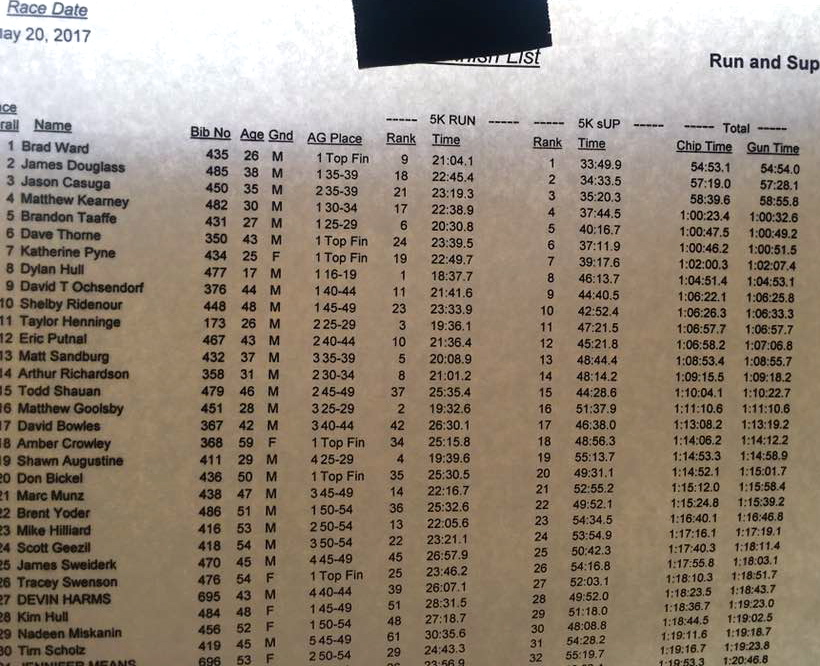
Participants and Gear: This event has grown every year since its inception, and had 599 total participants this year. Many just did the run or the sup, but 100 did both. There might have been greater numbers of elite sup racers were this race not on the same day as the Florida Cup sup race in Tampa. The sup+run winners from last year, Brad Ward and Katherine Pyne, both returned, but with different boards. Brad recently got sponsored by Sunova boards, and was on their 14x25 flatwater model. It's an unmistakably unique SUP with a wood finish, neon green nose, deep dug-out standing area, and scale-like protrusions over the one-way valves that drain water out of the standing area. Brad let me try it after the race and it felt pretty fast and extremely stable. Katherine was on a 12'6 Bark Contender. Other multi-sport talented competitors who returned this year included Jason Casuga on a sleek 14x26.4 Bark D2, Brandon Taaffe on a 14x25 Riviera RP, and my CGT teammate Matt Kearney on his 14x24 404 v3. I used my usual 14x23 Riviera RP. There was a wide diversity of sup gear among the other competitors, from full carbon Hovie Comets to clunky, beginner-style rental boards. There were also some interesting modified sups and paddles for people with disabilities, and some high-tech racing wheelchairs for the run portion.
Results: Brad Ward won the men's division again this year, with 54:54 total (21:04 run, 33:50 sup). I was second with 57:19 (22:46 run, 34:34 sup), Jason Casuga was third with 58:40 (23:19 run, 35:20 sup), Matt Kearney was fourth with 1:00:23.4 (22:39 run, 37:45 sup), just ahead of Brandon Taaffe 1:00:48 (20:31 run, 40:17 sup). It was Matt's personal best 5k time. Katherine Pyne again won the women's in 1:02:07 (22:50 run, 39:18 sup). The next fastest female was Amber Crowley, who won the masters' division with 1:14:12 (25:16 run, 48:56 sup). It was interesting that there were some people who went MINUTES faster in the run than the overall sup+run winners, but didn't place particularly well because their sup times were over par. For example, 17 year old Dylan Hull ran a blistering 18:38, but took 46:14 to complete the sup.
Play by play: Since the race started at 8 am, I had to get up at 4:30 am to pack and drive to Sarasota. It's probably better to get more sleep before a race, but I don't think it made a huge difference. While setting up my stuff at the event site I had a scare when my board disappeared off the beach. Somebody had mistaken it for a rental board (I don't know how; it didn't look anything like the rental boards), separated it from my paddle, taken it for a spin, and deposited it at the far end of the beach. Fortunately I found it and sorted things out. The only damage was a minor nick in the fin where the dude had set it on the rocky ground without the appropriate tenderness. I'm going to put a sticker with my name on it on the board to avoid future confusion.
The running portion of the race was first. A few minutes before the start they corralled us behind the inflatable timing gate, gave us some last minute instructions, and two young women sang the Star Spangled Banner beautifully. The start happened, as advertised, at exactly 8 am. I was fairly near the gate, but still found myself in a traffic jam, unable to move until the layers of people ahead of me got moving. It was OK, though, because the timing chip corrected for when I passed through the start gate, which was about 10 seconds after the gun went off. Somewhere in that traffic Matt Kearney busted out ahead of me. I knew from our practice runs that we were similar speed on foot, so I tried to keep him at the same range as we proceeded along the path. Katherine Pyne seemed to be our speed, as well, so she was another good landmark. I passed Jason Casuga, who I think was pacing himself to save energy for the sup. (Last year Jason beat Matt and I in the run.) I felt OK until halfway through the run, at which point my inadequate running training manifested as increasing difficulty matching Matt and Katherine's pace. My feet and calves felt weird, and I alternated between toe-first and heel-first running styles trying to figure out which gave the most speed with the least effort. With about 500 m left I started to slip behind, but I wasn't more than about 10 seconds behind Matt at the end of the run.
The run transitioned directly into the sup; no break. I hustled to the water's edge, pulled off my shoes and socks, and hopped on the board with a running start. I think I did that part better than last year, although in some video that Matt's parent's took you can see that I bobble awkwardly on my third stroke, still finding my sea legs. Since I was close behind Matt and Katherine, and I paddle a little faster than them, it didn't take me long to pass them. Then it was just a long grind to get around the lake. I could see Brad Ward far ahead but I knew I'd never catch him. I was more concerned with whether or not I could catch the fast runner / slow paddler guys before the end of the race. I was worried that some of them might have practiced their paddling since last year and become a lot harder to catch. With some relief, I got up to Brandon Taaffe before the mid-point of the sup circuit, which was earlier than I'd caught up to him the previous year.
I made a big mistake on the short side of the rectangular lake, though, when I paddled most of the way straight across, into the wind and the sun glare, before realizing that the buoy was actually about 100 meters north of where I thought it was. (You can see the diagonal on Matt's GPS track.) As a result I ended up paddling an elbow instead of a shorter diagonal, probably adding 20 or 30 seconds to my time. Oh, well. The second half of the paddle had more favorable winds, and I got in a good rhythm, putting more distance on Jason and Matt. Brad Ward was finishing just as I rounded the final corner of the lake. I tried to keep good speed all the way to the beach. For some reason I decided to carry my board with me with me as I ran through the finish line. Maybe I was feeling possessive of it after that pre-race incident.
Overall, I felt pretty good about the race and my result, despite some regret over my navigational error and unnecessary board carry. I'd like to do some more running cross-training to see if it can help me with my SUP, and to see how much faster I can get. Many professional sup athletes like Annabelle Anderson and Michael Booth incorporate a lot of running in their training, and I think it might help their "pep," endurance, and leg strength for rough water. I sure feel "worked out" today after that race yesterday (plus a sweet 20 knot wind windsurfing session when I got home in the afternoon).
Other race intrigues: It was excitingly close between Jason Casuga, Matt Kearney, Katherine Pyne, Brandon Taaffe, and Dave Thorne. Matt didn't pass Brandon Taaffe until the very last ~200 m of the race, making for a nail-biting finish. After the race there was a nice, festive atmosphere with a good MC doing the awards, good free food, and some inspiring words spoken recognizing the brave, wounded veterans who are the focus of Operation Second Chance.
What's Next: The CGT Race Series next local race is coming up May 28th in Bonita Springs. Next big race is also relatively local, the Battle on the Blueway June 10th at Fort Myers Beach.
Sunday, May 7, 2017
SUP Race Report: Noodles SUP Luau Race
Race: The 8th Annual SUP Luau Race, sponsored by Noodles Italian Cafe & Sushi Bar, Beach Box Cafe, and B3 Marketing LLC. Benefitting Collier County Special Olympics.
Date it happened: 7 May 2017
Location: In the Gulf of Mexico at Vanderbilt Beach, Naples, FL.
Distance: The competitive race was approximately 5.3 km, but I don't know the exact distance because I forgot to start my GPS tracker. The race was 6 laps around a triangular course, with two buoys offshore and one in the surf zone. That inside buoy provided a good challenge for the competitors and drama for the spectators. After the competitive race there was also a short "family fun" race and a race for the Special Olympics athletes.
Conditions: There was a light side-offshore wind from the NE, and some knee to thigh high swell breaking near the steep sandy beach. For those who weren't used to the rolling ocean conditions, balance was a major challenge, and there were several "retirements" before the race was over.
Participants and Gear: There was a big crowd for the family fun race, and there were quite a few Special Olympians, as well. The competitive race was a smaller group (17 people), but it included experienced studs Mark Athanacio and Packet Casey, among race-savvy competitors from the CGT tribe and Naples Outfitters. There were no divisions by board size, so most people used 14' boards if they had them. I used my 14x23 Riviera RP, with an 18 cm "Natural Winner" fin that I stole off of one of CGT's Starboard AllStar boards. I've previously raced with some fins that I thought were too big or too small for rough water, but this green one seemed like a good compromise.
The Goldilocks fin? I might look for an aftermarket fin that has similar specs, such as the Fins Unlimited 7.3" Seagrass SUP fin.
Mark Athanacio used his salmon colored 14x23.5 Hovie GTO, and Packet Casey used a 14x23 JP Flatwater that looked tippy (although it's the same board model that Vinnicius Martins recently won the Key West Classic on). Hal Atzingen used a 14x25 Infinity Blackfish with a 4-fin setup (3 at the tail and one little one towards the bow). Lots of people were drooling over that board. I tried it and was impressed with the stability but thought it might be faster with just a single fin. Matt Kearney used a 14x24 404 v3. Justin DiGiorgio used his Mahi Mahi colored 14x24 Hovie GT. Mark Hourigan used the same model of Riviera as me but with a Futures RedFish fin. John Weinberg used the 14x25 Riviera. CGT team manager Nick Paeno made a rare appearance on the race course with one of the shop's 14x24.5 Starboard AllStar boards. Meg Bosi used a 12'6 Bark Contender, and Donna Catron used a 12'6 Bark Vapor. Cindy Gibson volunteered at the registration booth but had to skip the racing due to a serious muscle injury she sustained while winning her division in the Key West Classic.
Results: Since this was a low-key local race focused mostly on the recreational paddlers and Special Olympics athletes, I don't think they are going to post our times. They did keep track of who got what place, though. I got first, followed by Packet Casey and Mark Athanacio. I think the next two finishers were Matt Kearney and Justin DiGiorgio, who rode in on the same wave but varied in how gracefully they dismounted and ran up the beach. Meg Bosi was the first female. If they'd had age divisions, Athanacio would have won the 50+ division by a wide margin.
Play by play: No buoys were set up yet when we got to the beach, so there was a lot of speculation on what the course would be like while we paddled around and warmed up. Initially we thought there would be running up the sand and around a cone or something between laps, but it was decided instead to just have us go around a buoy near the shore. That turned out to be challenging enough, since the buoy was flanked by breaking wave zones. We also weren't sure how long each lap of the course would be and how many laps there would be, but after we saw where the outside buoys were placed (pretty close in) we collectively decided that 6 laps would be the right amount. I'm glad we didn't do more because some of us had trouble counting to 6. It starts to feel like Groundhog Day after about the third lap. The direction of the course was counterclockwise such that each buoy turn was a left turn, advantaging "regular footed" paddlers, like me, for whom left turns are easier.
The start was the standard type of beach start, and I was lucky to get out relatively cleanly from the favored end of the line. Athanacio got the best start, and dreadlocked Jesse from Naples Outfitters also had a fast starting sprint on his 12'6 custom 404. Packet Casey didn't have as great an initial position, but subsequently sprinted fast and took an outside line to get ahead of me and Jesse. I had a little trouble with Jesse's wake, but I think I passed him before we got to the first buoy. I don't think I caught all the way up to Packet on the first lap, but I stayed pretty close behind him, and he stayed pretty close behind Athanacio. Each of the three legs of a lap had a slightly different character. The first was a bit upwind, and a diagonal angle to swells. The second was vaguely downwind, but the wind was too light to make a noticeable difference. The third leg was straight in to shore, and that's where it paid to time your paddling with the swells to get some boosts of speed on the way to the inside turn. I think the third leg is where I closed some distance on Packet and Athanacio.
My first inside buoy turn was decent, and got me in a position where I could catch up to and draft Packet for a while on the second lap. In flat water I probably wouldn't be able to catch Packet on his 14x23 JP Flatwater, but he had just enough instability wobbles in these conditions that my slightly-more-stable 14x23 Riviera RP was faster on average. Athanacio was still out ahead at that point, but at the end of the second lap he fell on the inside buoy, which had drifted impossibly close to shore. I was also forced off the board at that point, but corrected course and jumped back on without much fuss.
The messy turn after the inside buoy drifted to shore.
The details of the rest of the race start to get fuzzy in my head, but I remember that in subsequent laps I continued a routine of drafting Packet when possible, and trying hard not to fall off at the buoys. Sometimes I did "real" step-back turns, while other times, particularly if I was in the lead, I did less risky cross-bow or arc turns. The inside buoy got both Packet and Athanacio at least once more, which shuffled things around such that each of us spent some time in the lead. We started to lap the slower paddlers, which created a bit of traffic problems, but nothing too serious.
Going into the last lap I had the lead, and tried to pick up the pace slightly to reduce the chances that Packet or Athanacio would pass. Packet later told me that he'd been planning to do a big sprint around me during the last lap. I knew that plan didn't work out for him when I heard him splash into the water behind me halfway through the last lap. I picked up the pace a little more to make sure I had a safe gap and had used up most of my energy by the finish. I managed not to fall on the last leg, and rode a wave ungracefully up onto the sand at the finish line, putting some scuff marks on the nose of my board.
I'd barely had time to lay my board down in the sand before Packet finished, and Mark was just a few moments behind him. The three of us fussed with each other a little over who'd had the better luck with the buoys, whether we had actually done the correct number of laps, etc. I wished I had managed to start my speedcoach GPS properly so I could retrace each lap. Fortunately, Packet's memory of what happened each lap was really clear, and established that we had indeed done all six. Anyway, I was happy to have done well in the interesting, open-water conditions at this race, and to have finished alongside two of Florida's original SUP racing badasses. Athanacio is now 52, and Packet is 40-something, but both continue to punch well above their weight in the Florida SUP circuit.
After the competitive race was over, it was delightful to watch the huge mob of inexperienced but majorly-stoked racers in the family fun race. Some were really charging, some were thwarted by the waves and barely making headway, but all showed admirable determination. I think that a large volume of low-key amateur participation is a good sign of a healthy sport.
The Special Olympics race was also fun to watch, though it was tense watching the challenged athletes face bigger waves than most had ever paddled in before. Miraculously, they pulled through, and a few even managed to surf their waves back into shore as they returned from their short run out to the buoy. Woo hoo!
Family fun racers and some Special Olympians prepare for combat.
What's Next: Next up is more training, working on rough water and race skills, and getting read for the Florida Cup race later this month. Nick Paeno and John Weinberg, who opted to retire early from this race after falling a lot due to lack of practice in bumpy water, are keen to get some more rough water practice, and coach Athanacio has a new combination paddle-run workout that he has recommended we all try.
Tuesday, May 2, 2017
SUP Speed Analysis, 14' vs. 12'6, Male vs. Female
Here's what I see:
1) 14' boards are about 0.5 kph faster than 12'6 boards, on average. This makes sense, because the theoretical "hull speed" of a 14' board is 9.3 kph, vs. 8.8 kph for a 12'6 board.
2) There are big differences in how "stacked" the various board classes are, as calculated by the percent difference in speed between the first place finisher and the fourth or fifth place finisher in each class. Men's 14' and women's 12'6 class are the most stacked, and women's 14' class is the least stacked. Conclusion- It would be great to get some more women in the 14' class.
Men's 14' Class- 8% difference between 1st and 5th
Women's 12'6 Class- 11% difference between 1st and 5th
Men's 12'6 Class- 18% difference between 1st and 5th
Women's 14' Class- 40% difference between 1st and 4th (only 4 competitors)
3) Looking just at the differences between the 1st place finishers in each class, the fastest men are a little bit faster than the fastest women. However, this difference is pretty small. In both the 14' and the 12'6 classes, the first place female is faster than the 5th place male.
Saturday, December 17, 2016
SUP Race Report: Lovers Key No-Name-Race
Race: Lovers' Key No-Name Race.
Date it happened: 17 Dec 2016
Host: Naples area fitness trainer and CGT Race Team coach Mark Athanacio organizes these free "no name races" a few times a year.
Location: Lovers Key State Park, North Parking lot next to the Big Carlos Pass bridge.
Distance: It's about 9 km / 5.6 miles around the island, but the exact distance can vary depending on how much you cut corners or follow the channel.
Conditions: It was a beautiful, warm December day, with an ESE wind around 10 knots. The tide was very low and still ebbing, so optimizing the route to avoid shallows and strong current was important. We rounded the island clockwise, so the wind and small chop were in our faces for the first leg, on the bay side of the island. In the second leg, on the ocean side of the island, the wind was at our backs and there were some opportunities to ride bumps.
Participants: There was a good turnout of about 20 racers. Racers included the usual CGT paddle tribe, plus some of Athanacio's friends from other sports who don't usually SUP race, plus a SUP racer or two from the East Coast of Florida, such as Mary Ann Boyer Willis.
Gear: I used a 14x23 Riviera RP raceboard with a Riviera Bump 8.0 paddle, and a Fins Unlimited 6" Keel fin. Devin Turetzkin and Mark Hourigan used 14x23 RPs, as well. Mark Athanacio used his 14x21.5 Hovie Comet GT. Matt Kearney used a 12'6x24 Hovie Comet ZXC. Tadem Stewart used a new 14' Naish Javelin and Steve Fleming used a 14' Naish Maliko. All the women were on 12'6 SUPs- Mary Ann Boyer on an Indigo, Cindy Gibson, Damien Lin, and Donna Catron on Hovies, Meg Bosi on a Bark, and some of the other ladies on MHL custom boards.
Results: Mark Athanacio won first place, finishing in just over 59 minutes, while I was about a minute behind in 1 hour even. Matt Kearney was impressively 3rd overall and 1st 12'6, just edging out Tadem Stewart in 1:04:18. Mary Ann Boyer was the first woman, but looked to have been seriously challenged by rookie racer Cindy Gibson, who was only about two board lengths behind at the finish.
Here's my GPS track and data from the race. You have to log in to Strava to see the details.
Play by play: We started and finished from the beach. It was a little awkward because we had to launch out, but then immediately turn to the right to begin rounding the island. So the right side of the starting line was favored. Mark Athanacio had a great start that immediately put him a few board lengths in front of the rest of us. Matt Kearney, Tadem Stewart, and I also started aggressively, and for a while the three of us were about even with each other, behind Mark. Devin Turetzkin was in the mix, too. Tadem fell where some strong current was creating weird ripples, and I gradually outpaced Matt with my board length advantage, so it was soon just me behind Mark. I considered making an all-out effort to sprint up into his draft, but decided to set my own pace instead, and hopefully maybe catch him later if he tired out or ran into choppy water trouble with his ultra narrow board. As it turned out I had no luck catching Mark. Though I paddled hard, he set a blazing pace that I simply couldn't match, and he gradually extended his lead.
At the half-way point of the rounding we went through a tidal inlet called New Pass. There were some tricky shallow areas entering and exiting the inlet that frustrated me. Shallow water slows the board down and also prevents me from sticking the paddle all the way in the water, because it hits the sand below. One in the Gulf of Mexico we were going downwind, which was nice. Downwind with the assistance of following seas sometimes allows for speeds higher than can be achieved in flat water. Although I was getting occasional surges of speed, I was slowing down running into the backs of the waves at other times, so my average speed was breaking even with about what it would be in flat water. Heading into Big Carlos Pass was upcurrent and upwind again, so that final leg of the race was a draining grind.
Though my finishing time of 1 hour even was pretty good given the conditions, I'd like to find some more tricks or another level of fitness to catch up with Mark again. Including this time he has beaten me by a significant distance 3 of the last 4 times we paddled around Lovers Key. The one time I got him was a week ago when it was really windy and choppy and both of our times were slower than usual. I think my board may have better stability and handle ugly side-chop better, but when the chop is relatively small, Mark just makes his ultra light and narrow Hovie fly in a way that I can't keep up with. I'll keep at in the gym, work on my stroke technique, and experiment with a smaller paddle blade. I might also try to eat healthier, since that's one area where I have considerable room for improvement. I burn enough calories to not get fat, but I probably eat too much sugary fatty processed food, like cookies, hot dogs, pizza, and mac & cheese.
What else is new: There's another SUP race tomorrow morning, hosted by CGT. It's only about half the distance of the Lovers' Key rounding, but it's challenging in a different way because it's more of a sprint.
Saturday, June 25, 2016
Maximum Heart Rate and Training Zones Excel Calculator
1. HR is a measure of how many times your heart beats in a given time period. It's usually expressed as bpm: beats per minute.
2. Your heart beats slower when you are resting, and faster when you are exercising.
3. There is a big difference between your "resting HR" and your "maximum HR".
4. Exercise scientists divide the range between resting HR and maximum HR into about 5 "zones" of exercise intensity.
6. Each person's resting HR, maximum HR, and zones are unique to that person, but there are some trends in HR based on age and fitness level.
7. Resting HR is usually 50-80 bpm, but it tends to be lower in more fit people and higher in out-of-shape people.
8. Maximum HR tends to be >200 bpm for kids, and decreases steadily with age. Fitness training doesn't increase your Max HR, but it might help maintain it as you age.
9. There's a "rule of thumb" for calculating your maximum HR. It's: Max HR = 220 - Age. There's also a more precise formula: Max HR = 211 - (0.64 x Age). (Nes et al. 2012)
10. Due to natural genetic variability, it's common for your true Max HR to be up to 20 bpm higher or lower than the Max HR predicted by the formula.
11. To figure out your true Max HR you need to do a "stress test," which involves exercising, increasing the intensity to 100%, and measuring your HR at that point. Fun!
There are lots of charts and guides figuring out your heart rate zones and training, but I wanted to make one that could be easily customized for an individual. So, I came up with the excel version below. Try it out and let me know what you think.
Sunday, May 1, 2016
SUP Race Report: Key West Paddle Classic
Race: The Key West Paddle Classic, organized by the Lazy Dog and sanctioned by the WPA.
Date it happened: 30 April 2016
Location: Higgs Beach, Key West, Florida.
Distance: The main event was a race around the entire perimeter of Key West, approximately 12 miles. I had 18.82 km on my GPS at the end, which is 11.7 miles. There was also a 4 mile race, which was two miles into the wind from Higgs Beach, then two miles back.
Conditions: It was sunny, hot, and humid with a significant ESE wind around 10-15 knots. We started and finished by going downwind, but much of the race was into the wind or sort-of into the wind. There were also strong currents flowing from the Gulf of Mexico to the Atlantic because the tide was ebbing. The currents were against us going through a bottleneck at Fleming Key Cut and were weakly in our favor later when going through Cow Key Channel. There were a variety of shoreline obstacles, shallow water hazards, boat wakes, etc. In a few areas there were dangerous metal pipes, spikes, and pilings half submerged in the path of the race, which could shish-kabab a person who fell on them. I saw at least one guy (Jake Portwood) had some bloody scrapes after the race, but I'm not sure exactly how he got them.
Participants: There was a huge turnout for this race, which is perhaps the highest profile SUP race in Florida. It even attracted some international pros including Kelly Margetts from Australia (Lahui Kai boards), Vinnicius Martins from Brazil (JP Boards), Belar Diaz from Spain (ECS boards), and Larry Cain from Canada (Starboard). The usual best-in-Florida hotshots were there, including Kieran Grant (Hoviesup) and Garrett Fletcher (Yolo Boards), who got 4th and 5th in the mens' 14' class. Young Joey Huemphner (BOTE/Darkroom boards) got 1st in mens' 12'6, followed closely by Steve Miller (Starboard) and Jake Portwood (Hoviesup). Seychelle Hattingh (Mistral) and Kimberley Barnes (Riviera) were 2nd and 3rd in womens' 12'6, after North Carolina's amazing April Zilg (Hobie SUP). I traveled to the race and split a room at the Sheraton with my CGT Race Team buddies Matt Kearney and Devin Turetzkin. Also representing CGT we had the South African Riverbeest Murray Hunkin and his sweetheart Saralane Harrer.
Results: 116 sup racers finished the around-the-island race; 83 men and 33 women. There were also a lot of people who did it on Kayaks, Outrigger Canoes, and various other paddlecraft. Of the sup racers, Vinnicius Martins, Kelly Margetts, and Larry Cain were the top three 14' sups, in 2:04:46, 2:05:06, and 2:07:34, respectively. I finished 10th in the 14' class, with a time of 2:23:00. I was just behind the first place 12'6 (Joey Huemphner) who had 2:22:05, and just ahead of first place woman (April Zilg on a 12'6) who had 2:23:32. My race wasn't perfect (see play by play), but I was pleased to be in the top 10 for my class. My buddy Devin Turetzkin, who just got a new 12'6 x 25" Hovie Comet GT, got first place in the over-50 12'6 class with 3:04:43. Skinny Matt Kearney battled the wind (which is worse for lightweight guys) to an admirable 2:51:09, just behind exercise physiologist Dr. Jose Antonio (the protein doctor guy who we did the study with at Nova Southweastern University). Full results are posted on the SUP Racer website.
Vinnicius Martins winning.
Kelly Margetts second.
Larry Cain third.
Seychelle Hattingh and Kimberly Barnes 2nd and 3rd
Me at the finish.
Gear: I used my usual 14'x23.75" custom carbon Riviera RP raceboard. I tested it out first with a short 6" Fins Unlimited fin, but I felt like I needed more stability in the rough water, so I switched to a 9" windsurfing weed fin, which helped. (Amazingly, I never fell during the race.) I used the Riviera Vantage R8 paddle that I recently cut down to 77". I felt weak in the upwind/sidewind sections of the course and had trouble maintaining a strong/fast/dynamic stroke. It seems like a lot of good racers, even big strong ones like Larry Cain, are now using smaller paddle blades than me, and I think I ought to experiment with that. Also, I need to practice more in upwind/choppy conditions to find the right rhythm and pacing.
Play by play: The race had a very spread-out start, from the water, along an imaginary line perpendicular to the beach. I chose to be pretty far from shore so that I'd have a more directly-downwind shot to the first turn. There was supposed to be a 1 minute warning from a jetski before the start, but I didn't see or hear the warning and I was about 60 meters behind the front of the pack when they blew the starting horn. Doh! Lesson learned- always be at the front of the group ready to go, because you never know exactly when the start is coming.
The first leg of the race was a "downwinder," which I can do, but not skillfully. I can stay upright and intermittently catch bumps that accelerate me to 10-50% over my normal flatwater paddling speed. But I spend a lot of energy balancing, and between the fast "glides" I often drop below normal flatwater speed or get knocked off course. Therefore my average speed in a downwind section is only a bit faster than I would go with the same effort in neutral conditions. In contrast, the pros like Kelly and Vinnicius are really effective at catching every possible glide and maintaining a rocketing average speed downwind. A few minutes after the start they were just specs in the distance to me. At least I didn't fall down, and I worked through the slower part of the pack up to the riders who were about my speed.
The end of the downwind was a rock jetty at Fort Zachary Taylor, where we turned North into the Key West shipping channel. I did ok there by staying close to shore where there was less current, which allowed me to get past Sam English, who was charging hard but too far offshore. I gradually started creeping up on another strong paddler, who I realized was April Zilg on a 12'6. Neither of us could draft the other because it's not allowed, but I passed her (with difficulty) and focused on a couple of male riders who were ahead but still within possible catch-and-draft distance. The sharp right turn into the strong current of Fleming Key cut was tricky and caused Bill Swezey to fall about 50 meters in front of me. In retrospect I should have given it my absolute everything to catch him at that point but I felt too tired at the time to pull off something like that, and I had my own troubles negotiating the current around the bend.
Fighting that current in Fleming Key Cut sucked big time, even when doing the trick of paddling just an arms' length from the seawall. I wasn't getting any closer to Bill Swezey, and I wasn't get any further from April Zilg. I decided to gamble and cross the channel early to try to escape the treadmill. It could have gone horribly wrong, but it didn't. After squeaking through the nasty current under the Fleming Key bridge, I saw that I had sort of gotten in front of Bill Swezey, Robert Hess, and Belar Diaz. But I was tired, still in a substantial current, and now fighting side-wind and chop coming across a wide open bay. I was also a bit downwind of those three fast guys, and when they crept up on the upwind side I couldn't muster the strength to get over and join their train. I felt very weak and demoralized at this point. My left side paddling muscles hurt from only being able to paddle on that side, my cadence slowed down, and psychologically it felt like every stroke was weighed down with the pain of knowing how much more of the race was still to come, and how much of that would be fighting the wind.
It was a huge relief to get into the smooth water in the lee of Dredgers Key, where I could resume paddling on both sides and regain some kind of rhythm. I was still feeling kind of sorry for myself and in survivor mindset more than killer racer mindset, though. I think this was where Jake Portwood and some other of the fast 12'6 riders got ahead of me, and April Zilg was pulling up next to me, too. The next section was straight into the wind and chop across another open bay into Cow Key Channel. The going was slow, but I started to get a minor second wind. Focusing on counting strokes in my mind helped me find some semblance of a rhythm that adequately advanced me into the wind. It was good seeing the speed go up on my gps as the water smoothed out I got into the tidal current pull of Cow Key Channel. Picking which way to go in the channel was hard, but because the assistance from the tidal current seemed relatively weak I decided to take the shortest path, hugging the west side of the channel. I knew there was a shallow water hazard at the end of that path, but it turned out to be not too bad. That move didn't quite catch me up with the three 12'6 guys who had passed me earlier, but it did get me in front of April Zilg, who had gotten ahead of me in the channel just before I forked off.
The final stretch was about 45 degrees downwind, which is tough. It's hard to properly ride the waves when they're coming at you from that angle. And when you do catch them they tend to carry you off track. Ahead of me I saw the top three 12'6 guys battling hard. Joey Huemphner put on the afterburners and left Steve Miller behind. Jake Portwood fell down several times and lost his lead. My body was worn out and I was focused more on staying upright and pointing in the right direction than on speeding, but I did get some glides, and I managed to pass Jake and Steve near the finish line pier. I put whatever energy I had left into the last 100 meters to the beach, took off my leash at the last second, jumped off and ran through the whatchamacallit finish line thing like I meant it. Woo hoo!
Here's my speedcoach track and data from the race: You have to click into it to see the details like heartrate and stuff.
Other race intrigues: Some weird paddlecraft finished the race, including a giant canoe-catamaran thing with several people in each hull. That thing actually finished in 2:03, before the fastest paddleboard. A much slower multi-paddler inflatable paddleboard called a supsquatch got around the island in 4:16, which I think included a beer break. Individual paddlers continued to the finish the race all afternoon, the last few taking more than 7 hours to complete it on non-race sups. That's determination. Given the distance and the conditions, I'd say this was a race where simply finishing, regardless of how long it took, was a darn good achievement.
It was fun meeting new people at the race, including some friendly paddle celebrities like Olympic canoeists Jim Terrell (owner of Quickblade Paddles) and Larry Cain. The sport of standup paddleboarding is lucky to have both of these guys involved. Terrell has really put a lot into the paddle design and stroke technique analysis side of things with his Quickblade business, and he has also shaped some crazy raceboards that have pushed the limits of the sport. The board he used in the Key West race was his own design and looked pretty cool. Larry Cain is also into the technical side of paddling and has lots of detailed technique tutorials and equipment commentaries on his blog. He's also known for having kept himself in ultra-fit shape even decades after his Olympic canoeing days, and he gives some really interesting athletic training advice on his website. Murray from the CGT team knew Larry because they had trained at the same canoe club in Canada, so he introduced us. Though he's intimidating looking, with arms like oak trees and a torso as broad as a manta ray, he was relaxed and friendly when we talked with him. He was even patient with me while I picked his brain about some gear and training questions that had been on my mind.
What's Next: This race made me realize I need to work on both physical and mental aspects of my upwind power and long-race endurance. Lately my training has been almost all short-distance high intensity stuff in flat water, alternated with a couple days per week of strength training with weights. This approach has definitely improved my short-to-medium-distance race speed, and I think the strength training (which I'm still in the early phases of) will ultimately also help my muscular endurance for upwind and long races. I don't feel out of breath when going upwind or in the second hour of a long race. It's more that I feel enervated, like my strength is drained and I'm paddling through molasses. I need to toughen up and get my mind and body used to maintaining race pace for a long time and in bad conditions. I'll have to experiment to see what the best way to do that is. On this matter Mark Athanacio and Larry Cain have different opinions. Athanacio advocates intense, relatively short workouts that quickly produce exhaustion and train you to maintain speed through that exhaustion. An example would be paddle sprints in the ocean interspersed with beach runs in the soft sand. I'm less familiar with how Larry trains himself and his athletes- I think there are some similarities with what the two experts do, but a big difference is that Larry includes lots of "volume," with long time, long distance paddles. Larry's reason for doing the volume is to build a "base" so that the distance part of long distance races becomes easy for you, and Athanacio's reason for avoiding it is to prevent injuries and overtraining symptoms. I suspect it's one of those things where there's some truth to both views, and the most effective type of training may vary by the individual and what kind of mind and body they have. One thing that Athanacio and Larry agree on, though, is that people who ONLY train with steady long distance paddling never get faster, so the high intensity intervals have to be part of what you do.