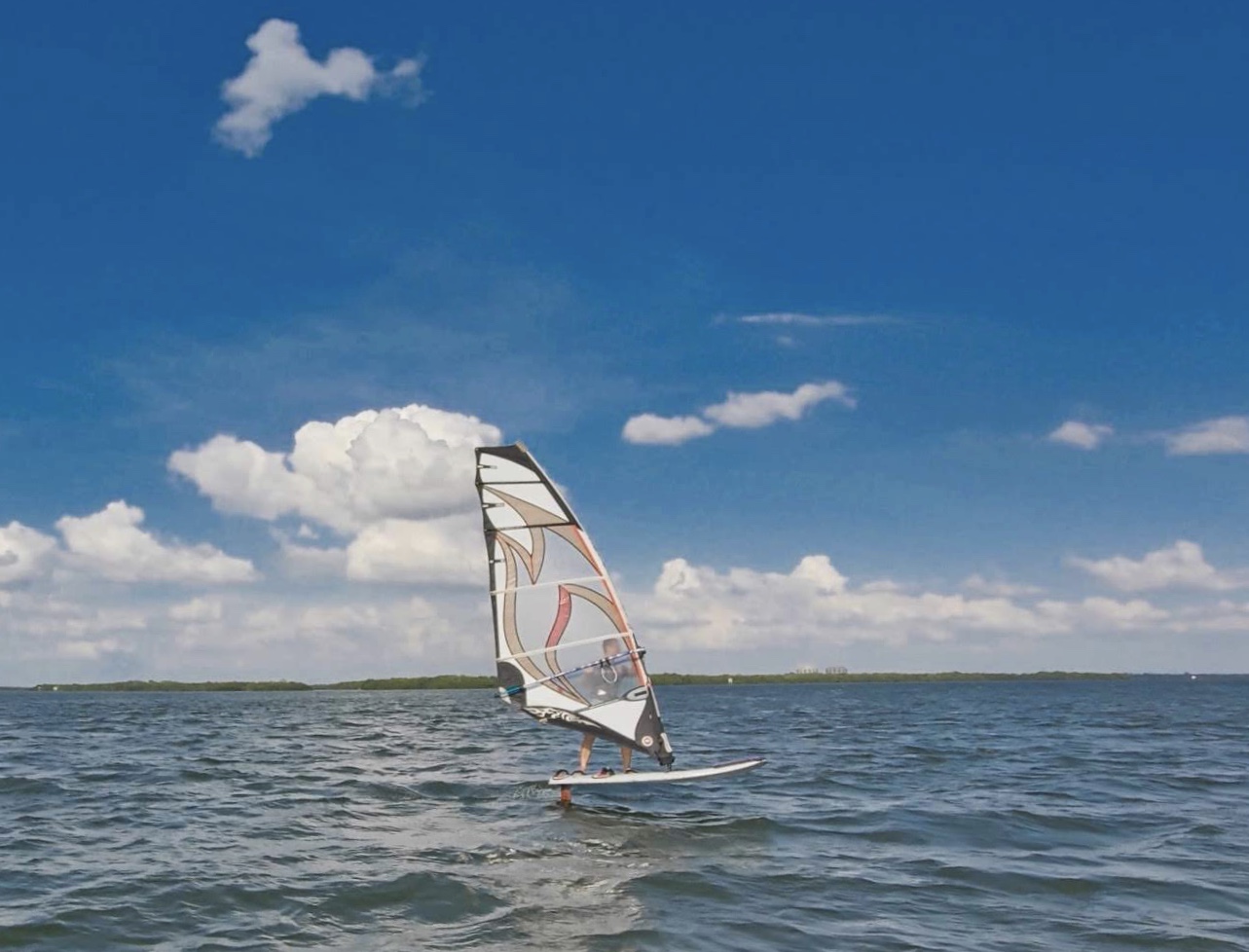
Hydrofoil windsurfing is great. I'm still using the "Slingshot Infinity 76" hydrofoil that I got in 2019 and first blogged about here. The only difference is that I mount it to a different board now; a Fanatic Skysup. (Boom mount video of me riding the skysup in 2021 here.)
Today's session was at Bonita Beach access #10, which is finally starting to get back to normal after being leveled by Hurricane Ian in 2022 and messed up again by Hurricanes Helene and Milton in 2024. In just the last couple of weeks the county added some dune plantings, which I have learned from my colleagues at FGCU are VERY effective at gathering windblown sand and reducing beach erosion during storms.
It seems like some plants have also recruited to the dune on their own, like the railroad vine, Ipomoea pes-caprae.
When I arrived at the beach it was quite breezy but I wasn't sure it would be enough to use a 6.8 sail on my shortboard. I went with a 4.7 sail on the foilboard. (The rule of thumb is you use about 2/3 the size of sail for hydrofoil windsurfing as you would use for normal windsurfing.) When you're powered on the foil it's easy to go way upwind and downwind, so that's what I did, making these nice tracks. I crashed a couple times but didn't lose my sunglasses, and I saw a sea turtle, so I'm calling it a win.
On Friday I had a good windsurfing session on my newish hydrofoil windsurfing board, the Fanatic Sky Sup Foil WS. I filmed it with a GoPro camera mounted to the end of the boom. I was using a 4.7 sail, and the foil was a Slingshot Infinity 76 in the "B" configuration, set as far back in the finboxes as possible. The wind was around 15 knots from the SW.
I'm really liking this board now, although it was a major adjustment from the first board that I started foiling on; an older Exocet formula board. The Sky Sup is meant for maneuver-oriented sailing (as opposed to speed-oriented sailing), and is also meant to be useable without the sail for SUP foiling or with an inflatable wing for "wingfoiling." It's very short; 210 cm, and the mast track is placed very close to the front footstraps. The footstraps are near the centerline of the board rather than out near the edge like on a formula board. These aspects of the shape and the placement of the fittings required me to radically change my stance, sail position, and body weight distribution from what I'd gotten used to. The sail must be held with the mast straight up, or or even raked towards the nose a bit, rather than raked back towards the tail as it would be when sailing fast on a board with normal geometry. Controlling the altitude of flight is done more with direct foot pressure and less by applying weight to the mast base. Because of the sail rake angle you need to set the boom lower and/or use longer than normal harness lines if you want to hook in. You can actually sail it without a harness, though, since the forces in the sail are so much less than on a non-foiling windsurfer.
I've used the board with sails from 4.2 to 6.8 meters squared. It handles the 6.8 adequately, but the sweet spot is with smaller sails. Compared to the formula board, the Sky Sup is more particular about having the right sized sail for the wind. On the formula board you have some more leverage to keep the sail sheeted in and the elevation controlled when the sail is overpowered, whereas on the sky sup you just have to sheet way out. When underpowered on the formula board you can still get it foiling with some "stir" pumping of the sail that applies lateral pressure to the vertical part of the foil and translates into forward speed that allows liftoff. But that doesn't work as well on the sky sup, where pumping becomes more about "porpoising" the horizontal parts of the foil. As I learn to pump the sky sup better the liftoff threshold may end up being about the same as on the formula board, but for really gusty conditions I think the formula board may still be a more forgiving foil platform.
The most annoying thing about this new board versus my formula board is that they don't use the same "finbox" system for attaching the foil to the board. The sky sup uses a "pedestal" mount with four bolts that go into two parallel mast tracks and allow fore-aft adjustment of the foil position. The formula board uses a traditional, fixed-position "deep tuttle box" mount with two bolts that go down through the deck of the board. Further complicating things, the foil itself has different configurations placing the vertical attachment more forward or back on the fuselage, and I need it in "C" position for the formula board but "B" position for the sky sup. The whole change-over takes half an hour or so of sitting in the driveway unbolting and rebolting things, re-greasing the bolts, etc., so I kind of have to commit to whether I'm going to be using just the sky sup for a while or just the formula board for a while. I think what I'll do is use the sky sup in our "windy season," with 6.8 sail being the max and waiting for 10+ knots before attempting to use it, and I'll switch over the formula board around June when we get into the light summer winds where I need my 8.0 or 9.5 more often.
The other day my photographer buddy Greg and I were doing wind-powered hydrofoil things in Estero Bay and Greg took this good picture with his GoPro camera. It's me with a 4.7 sail on an old Exocet formula board equipped with a Slingshot Hoverglide FWind1 with 76 cm Infinity wing. The wind is in the 10-15 knots range.
Greg took the picture while balancing on his tiny 6'6" SUP board with a GoFoil Maliko 280 hydrofoil, which he has been riding with a 5.0 Duotone handheld wing. Greg is rapidly improving on that setup, which I can testify is not that easy to use- especially not in light, shifty, or gusty wind, where the self-supporting stability and precise control of a windsurf sail is nice to have.
I am REALLY enjoying hydrofoil windsurfing, which I think is worthy of a big new branch on the growing tree of human- and nature-powered water sports. Since windsurfing was invented there have only been a few other "branches" of innovation that compare in terms of significance: the advent of shortboard windsurfing in the 1980s, the light-wind shortboard revolution around 2000, and the spread of kiteboarding and standup paddleboarding also in the early 2000s. Hydrofoil windsurfing (aka "windfoiling") is not just a minor advancement or change in style. It's a revolution in terms of how little wind/sail power it requires compared to shortboard windsurfing, and it's a revolution in terms of how it overcomes the catch-22 of conventional windsurf design, which was always that your setup could either be maneuverable or powerful but not both. (In this way hydrofoil windsurfing gains some of the advantages of kiteboarding.) ALSO, foiling above the water is just a very cool, different feeling from planing atop the water- it's super smooth and quiet.
My windfoil setup, which is a Slingshot Fwind 2019 hydrofoil mounted in an old "formula" style windsurfing board, can get going in about 8 knots of wind. That is similar to the planing threshold of the formula board when equipped with a conventional fin. The foiling setup can go upwind and downwind at angles similar to what the conventional formula setup can do. The amazing thing is that the windfoil does this with an 8 meters squared sail, whereas the conventional formula setup would need a much heavier and more awkward 11 meters squared sail to perform in 8 knots of wind. And whereas the conventional formula windsurf setup maneuvers like school bus, when levitating on a hydrofoil the same formula board maneuvers like a sports car. In full disclosure, the one remaining area where the hydrofoil, or at least my hydrofoil, doesn't match the conventional windsurf setup is in pure speed. I might close the gap as I get more experienced, but right now it's hard for me to get the foil going over 15 knots, whereas it's pretty easy to get to 20+ knots when powered up on a conventional windsurfing shortboard. That's OK with me though.
Anyway, as with my past explorations of new (to me) branches on the water sports tree, there have been fun/scary challenges and skill-acquisition milestones in my windfoiling journey. Just getting up on the foil for the first time was one. That was mainly a fear thing- once I tried it the board popped right up. The next milestone was being able to stay on the foil indefinitely without touching down. Then there were some minor things like being able to get going efficiently, use different sail sizes, use the footstraps and harness effectively, sail upwind and downwind in control, etc. Actually, learning to sail the foil deep downwind was a significant milestone, because you have to confidently carve through a scary "power zone" when going from upwind to downwind.
Definitely the hardest thing I've attempted on the windfoil so far, though, is the foiling jibe. The planing jibe on a regular windsurfing board is hard enough, but on a foil board it's harder still, because the board is so sensitive to where your weight is distributed when you're up on the foil. It's not that hard to carve the foil board when you're securely in the footstraps, but to carve it smoothly as you're stepping across it to the other side and flipping the sail around is tough. My first few dozen attempts all ended in me either touching down on the water or breaching out of the water (and then crashing down). But during a great foil session in smooth water on Thursday night, I finally made it around once or twice without touching (or with just barely touching) the water. Woo hoo! I still have a very long way to go get my foiling jibe completion rate from 1% to 100%, but this is a start. The good jibes are towards the end of this video:)
I'm a marine biology professor at Florida Gulf Coast University. My professional page is here, my personal blog is here, and my no-longer-maintained science blog is here.