Showing posts with label dogs. Show all posts

Saturday, November 14, 2026

Helloooo less onerous task

Last week was a big one including a manuscript revision deadline, dog vet visits, giant stacks of term paper grading, an interminable Microsoft 365 shutdown, evening tabling as a "marine biologist" at a middle school career night, and a crazy Friday finale: a 13 hour chilly-in-the-wind boating and snorkeling field day to break down a six month long clam-seagrass co-restoration experiment. As least we got to see a cute baby octopus!
Anyway, when I was woke up this Saturday morning I was very much looking forward to doing NOTHING, or at least nothing responsible. Unfortunately, nagging responsibility interferred before I had even finished my coffee and doom scrolling. While walking the dogs (act of responsibility #1 of ?) I got the idea for a blog post / Venn Diagram about responsibility. Here it is:
My plan was to post the graphic, then do some term paper grading, which I would identify as an example of a "Least Onerous Task" per my diagram- One of those head-down-in-work-while-dodging-other-work activities that is simultaneously reponsible and irresponsible. As I crafted the diagram it started to work its cruel reality into my reasoning though, and I realized there was some ugly responsibility that would find me and kick my ass if I didn't undertake the extremely distasteful task of going through the two days of work emails that had piled up during the sequential Microsoft down day and snorkeling in the estuary day. So I DID that ugly and unpleasant work, including submitting an important project report (a day late). Eventually I got down to the beautiful (albeit fleeting) state of "email zero," and as a bonus I unloaded and stacked the dishwasher.

Yay me? I don't know. I think I can still achieve feeling guilty. The head-down term paper grading still needs to be done, the half-done paddleboard repair project on the patio isn't going to sand and epoxy itself, my bicycle's derailleur isn't going to realign by magic, the soymilk fairy won't replenish my fridge, and I should probably get some exercise and do PT exercises for my gimp shoulder. Such is life.

EDIT- No sooner had I posted this, than my bicycle expert buddy Max randomly called to say he was in the neighborhood and might drop by to hang out. I.e., my derailleur DID fix itself, plus I got to see my pal. I'm not saying karma is real, but this sort of unexpectedly wonderful twist of the universe thing does happen sometimes.

Sunday, October 16, 2022

Hurricane Ian personal story

Hello friends, family, and windsurfing- and science-curious strangers who happen upon my blog. I'd like to take a moment to tell the story of my personal struggles with big, nasty Hurricane Ian, which ravaged SW Florida even more so than Hurricane Irma of 2017. I'll tell the story in phases.

Phase 0: Before the Hurricane.
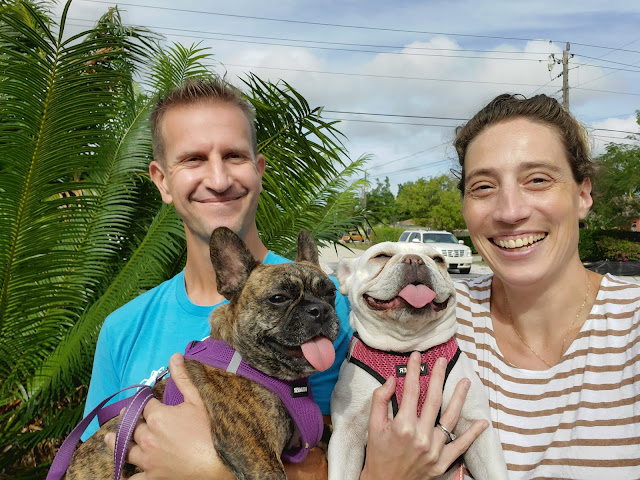
Prior to Ian, 2022 was going pretty well for Rhonda, myself, and our French bulldogs Petunia and Violet. I was busy with my job as a marine biologist at Florida Gulf Coast University- teaching classes, advising graduate students, and doing some fun research using scuba diving to study the effects of coastal pollution on underwater habitats offshore of Lee and Collier Counties. Rhonda was busy writing a new speculative fiction novel and working part-time as a store clerk at the HomeGoods down the street. We were looking forward to Rhonda's sister and nephew visiting.

Phase 1: Weather Watching
Up until September, the 2022 Western Atlantic Hurricane Season had been pretty dull. But it got spicy quick, with Hurricane Fiona becoming a big baddie that walloped Puerto Rico, the Dominican Republic, and even Nova Scotia. Hurricane Ian then took the stage, moving west through the Caribbean as a tropical storm then strengthening and turning north, with the western tip of Cuba and the Gulf Coast of Florida "in the cone." The early forecasts had it hitting somewhere north and west of us; Tampa Bay looked imperiled, but the Fort Myers / Naples area not so much. I cancelled my lab's plans to do scuba diving research, though, because the Gulf would be too rough and our crew would need to be making hurricane preparations at the university's Vester Marine Field Station. Rhonda had to cancel her sister's plan to visit. I got increasingly nervous while looking at iWindsurf.com forecast models which showed our coast getting a sustained beating from the onshore winds on the south side of Ian's counter-clockwise rotation. This was a scenario I'd also worried about when weather-watching Hurricane Irma- A storm offshore in the gulf can be more dangerous than one passing directly overhead, because of the way the onshore wind field can build a massive surge. Irma had caused major storm surge in the Florida Keys, but because it then then came due north over land it caused "only" wind damage and rainfall flooding in SW Florida. Ian, with a potential approach from the Gulf, looked like it could deliver the surge that Irma had only threatened. By Sunday the 25th some of the models and warnings coming out the National Hurricane Center were making it look really scary for us, fleshing out that storm surge from the gulf scenario. The NHC has a model now that can show a high-resolution, color-coded map of areas that may be inundated. The house we rent in Bonita Springs is only about 2 meters above mean sea level, and its near the tidally-influenced Imperial River; a water highway that can would conduct storm surge from the Gulf of Mexico, through Estero Bay, into my living room. So naturally it was flooding in those models, and each time I checked, like between teaching classes on Monday, it looked worse.

Phase 2: Evacuation
Work/school was cancelled for Tuesday the 27th, and a mandatory evactuation was ordered for low lying parts of Lee County that morning. In retrospect, the evacuation order should probably have come earlier. This is something that has become a major controversy in the hurricane's aftermath since so many people ended up dying in the storm who might have evacuated had the order come earlier. As it was, Rhonda and I had to scramble to make our evacuation plans, picking which of our friends or family outside of the hurricane's path we would choose to burden with ourselves and our not-quite-potty-trained dogs for who knows how long. Ultimately we decided that Valerie Dinsdale, our long time family friend who knows lives in Palm Beach Gardens in East Central Florida, was who we would crash with. We actually kind of dallied around our house on Tuesday morning the 27th, figuring we'd drive over later in the day and wanting to enjoy our coffee and not unplug our computers and stuff right away. In retrospect we should have dropped everything and frantically moved all precious things to the highest shelves and stuff. By the time we did get ourselves, our dogs, our dog beds, dog crates, dog pee pads, dog food, dog leashes, dog medicines, and other important things we didn't want to lose in a flood like our birth certificates and social security cards, loaded into the car, it was 6 pm or so and already raining hard. On the drive across the state we took back roads and avoided traffic, but the weather was hellacious, with our phones buzzing every five minutes with more emergency warnings of tornados, flooding, etc. etc.

Phase 3: At Valerie's
Despite getting drenched bringing stuff in from the car at Valerie's house, and struggling to get the dogs properly quarantined in her laundry room, we felt a lot of relief to be out of harms way. Valerie never lost power, so the next day we had a front-row tv and computer seat to the tragedy and destruction unfolding on the west coast of the state. I got intermitent text reports from my neighbor who had stayed home, and they were not encouraging. "Everything is floading." "We are evacuating." And later, "There is a tree on your house." You've surely seen the news reports so you know: it was BAD. As predicted the storm surge reached our house, and it was more than a foot deep around the outside based on the line left on the wall. We were anxious to return to see the damage and attend to the house, but we knew we couldn't go right away because we wouldn't have a safe place to keep the dogs air conditioned and cool. (Because of their brachycephalic heads and constricted air passages, bulldogs can't keep themselves cool in hot weather and they easily die of heatstroke. Rhonda and I still feel terrible about her English Bulldog Buri who died that way on the the 4th of July 2012. We think the Buri-spirit supported our decision to hang out with Valerie for a few more days.)

Phase 4: Coming home, sort of
I honestly don't even remember what exact day we left Valerie's, but it was a shit day. We had found an animal hospital open less than an hour from our house in the town of Labelle, so our plan was to drop the pups off there, then clean the house up and retrieve the dogs from boarding once we had power. The plan was derailed because it turned out that the "animal hospital" in Labelle was a squalid nightmare based out of an old schoolbus and damp, falling-down trailer, which reeked of mold and feces and of course had no power. So after a tense marital discussion we determined that we would travel to our home for just a few hours, keeping the dogs in the shade or in the air conditioning of the car, then Rhonda would return with them to Valerie's and I would stay in the house to do whatever I could to salvage things and make it habitable. Arriving at the house we could clearly see the black smudge of the high water line on the outside, and it was more than a foot up, pretty discouraging. Inside it was nasty and wet, but our forensic work indicated that the water inside had only reached about 10 cm / 3 inches deep. 10 cm was enough to ruin any water-absorbent thing on or low to floor. So that was all the upholstered furniture and the lower shelf of the bookshelves and filing cabinets, but thankfully not the bed, the futon, or the dressers that were on legs. The stench inside was a horrendous mix of rehydrated dog pee, sewage, leaf litter, mildering clothing, and wet drywall and insulation. We hurriedly mopped up the standing water in the low spots of the floor and started moving ruined things out to the curb, then moving possibly saveable things to the covered lanai area. Rhonda and the dogs left and I spent my first night sweating with windows open and no covers on atop the bed surrounded by an epic mess. The next day or so was all about moving stuff out, boxing up dry things that there were no longer shelves for (got a million giant tupperware things from the hardware store), jury rigging a window unit AC and dehumidifier on a generator with help from my work buddy Serge and Rhonda's cousin Mike. Concurrently I was in frantic negotiations with the landlord to see what to do about the wet drywall, which becomes an epic mold problem if not removed soon. I got the go-ahead to remove it, and got some tips from my paddle buddy Matt Kearney on how to do so. One of the worst things was just drawing the line around the entire house at exactly 26" high, which is tricky when you're moving things which have no place to go, crawling around like a mole inside closets, etc. I forgot to wear a mask the first day of drywall removal so I'll probably die of asbestosis, but I wore a mask after that. The one good part of those hell days of all work and no electricity was meeting and bonding with a bunch of my neighbors that I hadn't really known before. As messed up as my house was, I was actually among the lucky ones, since a lot of folks closer to the River or bay had head-high water in their homes and lost everything inside. Worst of all, of course, were the folks who lived near the open coast whose entire houses were knocked down and swept away. It does make one question the wisdom of rebuidling in some of the lowest, most coastal areas. I'd like to see folks find ways to turn those areas mostly into public parks and beaches.

Phase 5: The lingering nightmare
One horrifying discovery when removing the drywall, along with the spiders, roaches, piles of lizard eggs, pine straw rat middens, and actual TOAD under the sink, was that an addition to the house had tons of pre-existing rot in the walls from where the roofs of the new and old part of the house weren't mated right and water got in. You know the rot is bad when you can actually vacuum up boards like wet coffee grounds with the shopvac. It's like, if I ever wondered why my rent was cheaper than average, now I knew. The horror of the mildew and stuff abated once everything was dried and out and vacuumed out and bleached and carted to the mountain of house guts on the curb (matching the mountains of house guts all down the street, and in every adjoining neighborhood, for miles and miles), and the power came on and Rhonda and the dogs were able to come back. But it's still unsettling living in this frankenhouse where the dogs can run freely from any room into any other and we don't know if the landlord is ever going to fix it and wonder if we could afford a different place. My pay has gone up about 10% since I moved here in 2012, but the average rent in town is like 2 or 3 times higher than it was. Cherished luxuries I've enjoyed, like having a shed for windsurfing boards and water within walking distance to go paddleboarding in, are things I maybe shouldn't have taken for granted. Although I'm not sure the "water nearby" thing is the unqualified perk that it initially appeared, especially with the sea level rising and stuff.

Phase 6: Life goes on, and science
October 10th was my first day back at work at FGCU, with a full schedule of classes and all the usual stuff, plus a lot of hurricane talk and catching up. I had 276 unread emails on the first day- yikes! One of the important things in those unread emails was that my scientific collaborators on our EPA-funded SW Florida shelf research project had arranged an alternate strategy for getting our October sampling done despite our marine research station being trashed. That alternate way is a 7-10 day cruise onboard the Florida Institute of Oceanography's boat, the R.V. Hogarth. We leave from St. Petersburg Tuesday. I should have internet so I'll try to do some posts of our scientific findings. We'll also have a reporter and cameraman onboard from SW Florida's Wink News. We expect to find a lot of murky, polluted water, and possibly some nasty knock-on effects of all the pollution and rotting material that has been injected into the Gulf; effects like algal blooms and oxygen depletion smothering sea bottom life.

Saturday, December 25, 2021

Merry Christmas 2021

 Whew, it has been a real busy last 8 months or so of life. Lots of exciting but stressful work, spiced up with some unexpected challenges, anxiety about the coronavirus pandemic, environmental disasters, etc. Nevertheless I have a lot to be thankful for. Number one is my wife Rhonda, seen here where we're celebrating Christmas at her family's home in New Hampshire. 


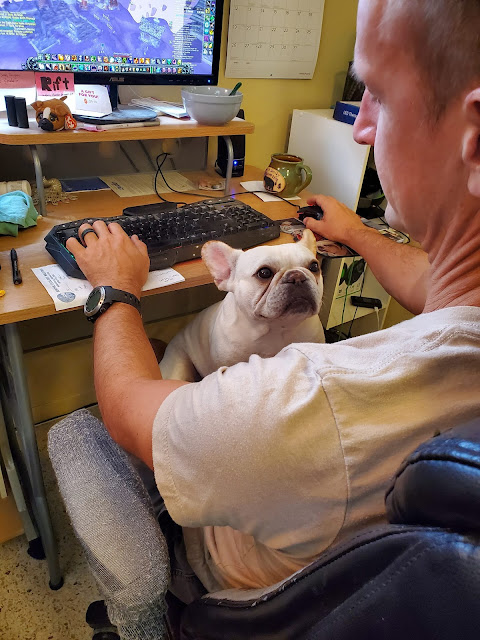
I'm also thankful for our new dogs- little french bulldog rescues Violet and Petunia who are a lot of work but super loving. Here Petunia is in one of her favorite spots, sitting in my lab while I play computer games. Those EYES! <3 


And here's one with the whole gang together. 


Saturday, October 7, 2017

(Belated) Hurricane Irma Story


Hurricane Irma passed directly over my town of Bonita Springs, FL on September 10th 2017 as a category 2 or 3 storm with winds in excess of 160 kph and ~30 cm of rain. It was a big deal. Some people lost everything. I was lucky to suffer little more than the disorientation of a 1.5 week “pause” in my life. This is my Irma story.

Phase 1: Weather watching- I have loved weather-watching and weather-hoping since I was a kid in Washington State. Back then my psychic efforts were concentrated on hastening the arrival of spring and summer sunshine, particularly willing the waters to warm to swimmable temperatures, and, in the winter, wishing the rain to turn to school-cancelling snow. When I got hooked on windsurfing as a young adult, the weather-watching centered on wind. I also began to mix science with my wishing. I would pore over the iwindsurf.com forecasts and sensor readings, and carefully strategize which beach to go to at what time to catch the best combination of wind strength and direction, tide level and flow, etc. Having by then moved to the East Coast of the US, I also started paying attention to tropical storms and hurricanes, which regularly influenced the weather of Virginia. Most of those brushes with storms in Virginia were harmless windsurfing fun, but Hurricane Isabel of 2003 was a category 1 direct hit that really messed up the Virginia Institute of Marine Science where I was studying, and left the area without power for several days. I regretted my decision to storm-watch from VIMS’ waterfront campus after my car window was smashed out by flying debris. Where I live now in Florida, hurricanes and tropical storms are the only kind of weather that’s interesting, so you can bet I do a lot of hurricane tracking and speculating, largely at the site wunderground.com, which has a good science blog discussion section along with their severe weather reporting. One of the things that concerned me this summer was how incredibly hot the water temperatures were in the Gulf of Mexico, much of it over 30 degrees Celsius. That’s hot enough to make you sweat while you swim. Hotter ocean waters give more energy to strengthen the winds and rains of tropical storms. The sea surface temperature “anomalies” (how much hotter or colder it is than normal) were skewed remarkably hotter, a trend becoming the new normal around the world, no thanks to man-made global warming.

The climate change stuff was definitely on my mind as I watched the terrible destruction brought to Texas by Hurricane Harvey. Then, before Texas had even dried off, a new storm developed in the Eastern Atlantic with a projected track that put Florida in the bullseye: Irma. I watched Irma get bigger and stronger, but thought it likely that she would curve out to sea; that the early track forecast of a direct impact to Florida would be wrong. However, each day the storm was stronger, and closer, and the westward track of Irma was narrowed the “cone of uncertainty” on South Florida. Remembering how beat up I’d been by category 1 Isabel in 2003, I wanted nothing to do with category 4 or 5 Irma.

Phase 2: Evacuation planning- It was hard to concentrate at work during the week of September 4-8, as I wondered whether, when, and where to evacuate. It didn’t seem like any of Florida would be a good place to go, since the whole state was in the “cone,” and even places not in the direct path of the storm would likely lose power (and precious air conditioning) for days. We considered two types of evacuation- 1) a short hop to more inland and northerly location in Florida, like a hotel in Orlando, or 2) a long journey to my parents’ house in Asheville, NC. Pros of the short evacuation would be less driving, and less time away from normal life if the hurricane damage turned out to be minor. Cons of the short evacuation would be finding a place that could take our dog, the expense of the hotel, and possibly needing to move again if our house was unlivable after the storm. Also, our geriatric bulldog-mutt Grace could suffer and die in a non-air-conditioned environment, so we needed the evacuation spot to be a guaranteed-cool place that we could afford to stay for a while. That argued strongly for Asheville. Thankfully, Florida Gulf Coast University (my employer) cancelled Thursday and Friday operations, which gave us plenty of time to make the long drive to NC before the bad weather. Rhonda and I packed up Wednesday night after my last class at FGCU (only three students attended the class), and prepared to leave early Thursday morning.

I was queasy thinking of how vulnerable our little rental house was: Lousy old windows that the wind whistles through. A poorly anchored aluminum shed in the back, leaned against a mahogany tree with branches enveloping the power and cable lines from the street. A decaying detached screen porch half-wrapped in Bougainvillea and Virginia Creeper vines. A palmetto palm tree that grew up too close to the house with its stiff fronds batting at the gutter and eaves. Towering pines and ungainly Ficus trees in the adjacent lot. I was fairly sure that the shed and screen porch would be destroyed by the wind alone, and that the house windows would break or leak enough rain to rust the electronics and rot the walls and furniture. I also thought it likely that all Rhonda’s fish would die and stew in their aquariums, even if the storm missed us. Wanting to get out on Thursday we didn’t have much time to prep the house. We didn’t board up windows or doors, but we did move the outdoor furniture into the shed, took the desktop computers to a friend’s safer house, and shifted a few things up off the floor and away from the windows. At the last minute, after sunset Wednesday night, I decided to hack all the fronds off the palmetto palm so they couldn’t bang into the eaves. While I was doing that I forgot to move the expensive gas barbeque grill into the house.

Phase 3- Evacuation. When we left at 6:30 am Thursday morning, all we had with us was our laptop computers, a box of personal identification documents, a week’s worth of clothes and toiletries, and the dog and her food. We drove Rhonda’s car, and left my “sport utility” minivan in the driveway stuffed with my windsurfing gear.


Leaving it all behind, was actually a kind of relief. I felt as if I had already said goodbye to the material things, and knew that the most precious pieces of my life were in the car with me or at our destination in Asheville. The adventurous feeling of escaping kept my mood more positive and energized than it would normally be on such a long drive. I enjoyed watching the natural scenery change from perfectly flat with tropical vegetation to gently-rolling with oaks and pines. At the same time the cultural scenery changed from “uniquely South Florida” to “kind of like the rest of the rural South”. It was nice to trade driving duties with Rhonda, and to make lots of little rest stops with the doggie. At those stops, and soon on the roads, as well, it became plain that we were not the only people evacuating from Florida. It was a dog and human ZOO at every gas station and McDonalds.

Traffic was slow between Tampa and Gainesville, and fairly excruciating from there into Georgia. After 16 hours on the road, in the dark of night, we were gridlocked well south of Atlanta. It looked grim and we debated stopping for the night. However, a turn onto the backroads opened up uncrowded territory, and we pressed on into a hilly land of big trees and small towns that was beautiful by moonlight. A Redbull caffeinated energy drink helped me stay awake for the last few hours through the northwest corner of South Carolina and into the western mountains of North Carolina. Finally, at 5 am, we pulled into my parents’ Asheville driveway and stepped out into the shockingly chilly September night air.

Phase 4- Asheville. My parents moved to Asheville from Washingon State a few years ago, but somehow I had only ever visited them at Thanksgiving and Christmas. So when I finally woke up it was a delight to see the scenic mountain town with all the green leaves on the trees and the pretty flowers blooming in my mom’s garden. Of course it was also great to see my folks, and my biologist Aunt Mary Garland and Uncle Tom who live in the same neighborhood. My dad had a heart attack earlier in the summer and has been on a strict “Ornish” diet and lifestyle program since then to get his weight, cholesterol and blood pressure down.

Dad making Ornish balls.


Apparently this Ornish thing is the only diet and wellness practice that has been scientifically studied and determined to actually clean out (rather than merely stabilize) clogged arteries. Old Johnny Douglass was looking studly and svelte for a 73 year old, and was in great spirits for a guy forbidden from eating any of his former favorite foods like BBQ pork and chocolate sundaes. I am extremely proud of him for sticking with something so difficult, and delighted that he’s doing something that greatly increases his chances of being alive and healthy for a good while longer. Rhonda and I went to Johnny’s “graduation” from his Ornish support group at the medical center, where we met some nice people who had also been prescribed the drastic lifestyle change at the same time as my dad. The graduation was an Ornish luncheon, some parts of which were wholesomely delicious and other parts of which gave me a greater appreciation for the adherents’ commitment to the program.

Some just-for-fun stuff that we did in Asheville included great walks and hikes in the mountains. I was especially stoked to drive to the high elevation areas along the Blue Ridge Parkway that are closed off when I normally visit in the late fall and winter. We even went to the highest spot of all, 2037 m Mount Mitchell, the highest point in the eastern United States. Above 1600 m elevation in the southern Appalachian Mountains there is a shift from familiar eastern deciduous forests to unique evergreen spruce and fir forests similar to those found far to the north in Canada. I had never been in that elevation zone before, and I found it remarkable to be bundled for warmth and surrounded by dark green fir trees in summer in a southern state. Mary Garland explained that one of the reasons Mt. Mitchell was so tall is because it was made of exceptionally hard rock, which had resisted erosion while the softer portions of the ancient Appalachians had worn away over the hundreds of millions of years since the Ordovician period.


A pensive moment atop the Craggy Gardens overlook.


Another feature of the time in Asheville was a streak of social dinners. Rhonda got to experience one of the hallmarks of my parents’ lifestyle- that they love to have company over, especially when sons and daughters-in-law are around. I hope my own circle of friends is similarly full and entertaining when I get to retirement age. It would also be cool if I can somehow live near my sister or Rhonda’s siblings like my dad lives near Aunt Mary Garland, since it’s a holiday-like treat to have them around, even if we’re not doing anything special. On this visit I got to hear Mary Garland play the banjo, which she appropriately learned after moving to the southern hills. She plays “old time” music, which is similar to bluegrass, and she’s really good! My mom has also learned to play the dulcimer. Someday maybe I’ll try playing the piano again. One thing I did entirely too much in Asheville was stare at Hurricane Irma news and forecasts on my laptop. The projected track shifted east (good for my town, bad for Miami) but then shifted west again to put Bonita Springs directly in its sights. As it looked like devastation of my home was highly likely, I persuaded my SUP racing buddy Justin DiGiorgio to break into my place and transfer my SUP boards from the vulnerable aluminum shed into the living room of the house itself. While he was at it he moved in the BBQ grill that I’d stupidly left out. Thank you Justin!


Phase 5- The Hurricane Hits. After devastating some Caribbean Islands at full category 5 strength, Irma spent a long time traversing the north coast of Cuba. While that was bad for Cuba, it degraded the storm’s strength and organization, particularly weakening its southern half, where the west winds resided. Irma re-strengthened to a marginal category 4 as it turned north and surged across the Florida Straits to the Florida Keys. It was dreadful to see it on the radar images, with the fluorescent violence of the eyewall smacking straight into middle/lower Keys. The next spot the eye came ashore was Cape Romano, where the dome homes I’d recently paddled to were. (Most of the domes are still standing, but two “sank” in the storm.) From there the eye went straight over Naples and my house in Bonita Springs, but that may actually have been a better scenario than if it had stayed a offshore where the winds would have pushed more of a storm surge to the north and west. As it was, only the barely-populated, south-facing coast of the Everglades got a big surge. The west-facing beaches from Naples and northward had a big NEGATIVE storm surge (the water went way out) due to the strong offshore east winds of the upper half of the hurricane, and had only minor positive storm surge from the weaker west winds of the lower half of the storm that passed over later. However, even that puny surge was enough to overwash the narrow dunes along the beaches in my town, salt-killing some of the seashore vegetation like the Sea Grape trees. The storm surge could have been MUCH worse, and we really were lucky that it wasn’t. What was bad was the wind damage. Even though the storm rapidly weakened, winds still reached over 160 kph where the eye passed over in SW Florida, which was enough to knock down TONS of trees, strip leaves and limbs off others, damage roofs, tip over fences and signs, etc. By some miracle, my shed survived, and I only lost one section of trim from my roof and one screen from my detached porch. (This was reported by Justin DiGiorgio when he inspected my house the next day.)


One part of the storm that was not merciful to Bonita Springs was the rain. About 30 cm fell onto soggy ground and drained into rivers and canals that had only partially recovered from flooding rains just two weeks earlier. The water quickly reached unprecedented highs and flooded lots of people’s houses. Some lower-lying neighborhoods on the east side of town had totally devastating flooding, and many of the houses I paddle by in the Imperial River had the river in their garages and living rooms. In fact, the AirBnB that my parents rented when visiting this January had a foot of water in it and all the furniture was moldering out on the curb when we got back to town.

Though it was a huge relief to hear that my house wasn’t destroyed, I had to suppress my urge to drive back right away. Reports from friends who stayed indicated that it was hellish and they wished they weren’t there. Not only was it horrendously hot and humid with no electricity, stores weren’t open, or didn’t have anything to sell. For example, it was nearly impossible to get gasoline for a few days. Plus, lots of roads were impassible because they were flooded and/or full of downed trees. There was no great urgency to return, anyway, because my work was cancelled until Monday the 18th.

Phase 6- The Return. Our unplanned vacation to my folks’ house in Asheville coincided with their planned seasonal migration to the Edisto Beach, SC house that they rent out in the summer but occupy for parts of the off-season. The timing and logistics of that migration were knocked askew by our visit, and by Irma, which caused some flooding, damage, and power outages on Edisto. Rhonda and I adapted by making Edisto an intermediate stop on our way home. I love any chance to visit Edisto and appreciated that it split the drive home into smaller segments. We left Asheville on the afternoon of Thursday the 14th and arrived at Edisto just after dark. There were lots of tree limbs down and sand and puddles in the road at Edisto, but the damage was minor relative to the major whallop the island received after Hurricane Matthew in 2016. Mainly Irma just made for more interesting beach combing there, with lots of strange shells and debris washed up.

After one restful day at Edisto, Rhonda and I bid my folks adieu and made an early morning departure for Florida. Traffic wasn’t bad, and as with the evacuation, the sense of adventure and excitement made the time shorter. Whenever I wasn’t driving, my eyes were scanning the roadsides for hurricane damage, expecting it to increase steadily the further south we got. At first the damage did increase. We noticed more trees down and billboards damaged as we headed down I-95 through Jacksonsville and St. Augustine. There was a fair amount of damage even as we turned inland on I-4 through Orlando. But oddly enough, there wasn’t much damage (at least not visible from the freeway) as we drove south on I-75. Even as far south as Punta Gorda things didn’t look bad. It wasn’t until we got to Fort Myers that we saw a major increase in damage, with many broken and uprooted trees, busted signs, etc. We took an earlier exit than unusual because it was reported that there was still water over the roadway near our usual exit. Once off the freeway there was a spectacle of chaotic damage. On our own street it was incredible. The entire vista was transformed by the knocked-down fences and absent tree canopies. It felt like there was more sky. Also incredible was the level of the little creek across the street from us than runs into the Imperial River. It was rushing and swollen and as wide as the Imperial itself, even days after peaking. I put on boots and walked to our friends’ house in a neighborhood along the creek, and sadly saw their house surrounded by the rushing water, which had clearly been in the house, as well.


A short walk to the Imperial River revealed it to be entirely filling Riverside Park where our SUP races take place, with only the tops of the park benches showing above the surface.


Though everything in my Bonita Springs looked damaged, perhaps the worst-looking disaster was the Everglades Wonder Gardens, and old-timey reptile house and botanical garden where it seemed all the giant tropical trees planted in the 1930s had come down and crashed on each other and over and through the tall wooden fences around the gardens. (I hear they’re selling the lumber though, which makes sense. There ought to be a fortune’s worth in timber, firewood and pulp just from all the giant piles of yard waste on everyone’s street front now.)

Inside our house it was 31 degrees Celsius and dank, but blessedly there was no serious water damage- just a tiny puddle in one closet where sideways rain had penetrated the hole drilled in the wall for the tv cable to come through. By some miracle, Rhonda’s freshwater aquariums still looked healthy and had some living fish. I think the ones that died probably nourished those that remained. The refrigerator and freezer were somewhat disgusting, but the fact that the power had been on for a day or two before we got back at least meant that the oozes had congealed enough to be easy to clean up.

On the second day of cleanup we dealt with the yard waste. My buddy Matt helped me chainsaw our downned mahogany limbs in exchange for me helping him out with a bunch of fun chainsawing at his house, including disassembling an entire huge avocado tree. I like chainsawing.


Phase 7- Moving on. Life is gradually getting back to normal now. I survived my first week back at work with only about double the level of disorganization and absent-minded professor confusion that I usually have. I tried to avoid the river because of stinking germ concerns, but I couldn’t stop myself from getting a nice 20 knot windsurfing session at Bonita Beach on Monday night. After that, and it may have just been coincidence, I got a cold that dampened the rest of the week, but it’s passing now. The morning I wrote this was the first time I got on a paddleboard since before Irma, and I did a loop around Big Hickory Island on Estero Bay with Justin. The ocean water is a little brown but has been certified swimmable by the Lee County organization who tests it. I am somewhat skeptical of that safety certification. The Estero Bay water is far more suspect. It looks like black coffee and smells like wet garbage. My graduate student Lisa was actually out in the Bay measuring its salinity and optical water properties on Thursday the 14th just a few days after Irma. Incredibly, she found nearly fresh water throughout the Bay (0 – 7 ppt salinity), even in areas that are normally near marine salinities (35 ppt). The combination of black water and very low salinities bodes ill for the seagrasses that Lisa and I are studying, which depend on clear, sunlit water and salinities >20 ppt. Compounding this “natural” disaster will be the extremely high concentrations of Nitrogen and Phosphorus washed into the water from all the overflowing septic and sewage systems, golf course ponds, farms, and other human sources of excess nutrients. They’re likely to cause harmful algal blooms that will negatively impact any remaining seagrasses. It’s an ugly situation, for sure.

While hurricanes are a natural phenomenon, their frequency, severity, and destructiveness are all increased by things that humans do. Global warming is the big one because it soups up the wind power and rain content of storms, and raises the sea level making storm surges go further. Another category of things we do that increase the destructiveness of storms includes removing or degrading the natural ecosystems that block or buffer the storm effects. For example, by letting coral reefs die we remove those natural breakwaters from our shorelines. Replacing beach dunes, marshes, and mangroves with coastal development removes those natural barriers and puts human structures in harm’s way. Inland, sprawling developments increase flooding problems by preventing the ground from absorbing rainwater, and concentrating all the water into overloaded and poorly-designed artificial drainage systems. To plan for the future we should take strong action to curb global warming, we should put the brakes on developments that are themselves vulnerable to flooding and storm surges and/or make other areas more vulnerable, and we should protect and enhance the natural ecosystems that process and store rain and floodwaters. In a best-case scenario, I imagine the wave of urban sprawl cresting about now, then tactically receding from the most vulnerable areas by not rebuilding the same way in the same spot when things are destroyed, instead shifting population density to sturdier structures on higher ground and yielding the beaches and floodplains to parks and nature.

Saturday, December 20, 2014

Using 14' Fanatic Falcon Race SUP for Windsurfing

As my wife Rhonda says, I am a notorious "min-maxer" when it comes to choosing and fine-tuning my watersports equipment. I proved this recently by swapping my nearly-new racing paddleboard (a beautiful blue 14' x 26" 404 Carbon Pintail Zeedonk) for a different model (a beautiful red 14' x 27.25" Fanatic Falcon).
The Fanatic was on consignment at CGT Kayaks and Paddleboards and I put my Zeedonk on consignment in its place. If you're in the market for a super-lightweight, all-carbon race sup for under $900 you can find my Zeedonk at CGT. Say you saw it on my blog and they might give you a discount. Here is why I did the switch:

1. I wanted to put a mast-track in the race SUP to mount a windsurfing sail, but I wasn't sure the 10 kg Zeedonk would hold up to the extra abuse it would take in windsurfing mode. The Fanatic is a few kg heavier with a thicker skin more like a standard windsurf, so I figured it would be a safer bet for windsuring use.
2. The noses on the two boards are different. The piercing bow of the Zeedonk works really well for paddling in flat water, but I could imagine it being tricky to negotiate through chop at higher windsurfing speeds. In contrast, the bow on the Fanatic is blunt and upturned, which I figured would make it more "self-trimming" in rough water. (Both boards are supposed to be good for open-ocean "downwinder" paddling and "catching bumps," but I think the Zeedonk takes a more active approach to fore-aft trim when doing that.)
3. When I borrowed the Fanatic for a test-paddle in the Imperial River I found that it was only a little slower than the Zeedonk. That was important, because I didn't want to totally sacrifice my hopes of keeping up with the faster SUP racers in the CGT race series this year.

So far I've been quite happy with the Fanatic Falcon. After pushing myself through some more training runs on the Imperial River, trying a new fin, and adjusting to the board's different style, I've got my course times down to where they were on the Zeedonk. The board is definitely an unusual shape, but it works. The bulbous nose is its most notable feature.
The nose is supposed to help it bob over waves and chop that it hits at a straight-on or side-on angle, and help prevent it from "pearling" under the water when riding down a wave. I paddled the board one time in choppy waves on the Gulf of Mexico. Though it was a lot less stable and less maneuverable than my Exocet WindSUP and Angulo Surfa, it was pretty powerful for catching waves and getting long, fast rides.

Balancing out the bulbous nose is a long-tapered, narrow tail with the fin set unusually far forward. This makes the overall outline of the board a teardrop shape, like the cross-section of a fin. There's minimal wake behind the board when in motion which implies minimal turbulent drag.
The weird straps on the front of the board are like suitcase handles for when you're running the board into or out of the water at the start or finish of a paddle race from the beach. I'm not sure I'll ever use them when racing, but they came in handy as tie-down points when I improvised a windsurf sail attachment system for testing purposes. (I wanted to see roughly if the board was sailable before I put any permanent holes in it.)
For the improvised system I taped a foam block to the bottom of a universal joint so that it could rest on the deck of the board without denting it. Then I tied the universal joint in place with a line to each of the straps, and a line to a little block of wood that I wedged into the recessed carry handle of the board. The carry handle is about in the middle of the board, and I assumed that the mast base would need to be just a bit in front of that.

When I got the board to the beach to test it with the jury-rigged sail attachment it was windier than I had expected; about 10-15 mph with some chop on the Gulf of Mexico. I rigged a 6.4 sail and took off like a shot. The board definitely accelerates quickly and goes fast in a semi-planing mode. In gusts it would get into fully-planing mode, but with a rooster tail of spray behind the tail, indicating a less than optimal pattern of water release from the unusual tail. The board handled the chop very well and went upwind at a steep angle when railed to windward. It took some work to tack, as expected, but it did tack. Jibing was easy because it would keep gliding on the long, voluminous tail even when I stepped far back on the board to make it pivot around. Overall it exceeded my expectations as a windsurf board, so decided to go ahead with the mast track installation.

The first step was to peel away the deck pad where the mast track would go.
The next step was to route out a hole a little bigger than the mast track. I filled the hole with a sandwich of high density pink insulation foam, with a layer of fiberglass between the two thin slabs of pink foam and a layer of fiberglass and filler between the pink foam and the foam of the board's interior.
After that cured I routed a hole within the pink foam just big enough for the mast track itself. (I bought the mast track from Roy Massey at Ace Performer.) The next day I put the mast track itself in, in a manner similar to that used for the pink foam. The final phase was to fair the excess fiberglass and epoxy off the top of the mast track and lay three layers of fiberglass over the area, overlapping with the mast track, pink foam, and some of the original decking of the board. I topped it all off with the piece of deck padding that I'd saved so it will look good less conspicuous.

I'm now on vacation at my folks house in North Carolina, but I'm looking forward to testing the real mast track when I get home in the new year. I'm curious how the board will work in really light conditions with an 8.0 or 9.5 sail, as sort of a poor-man's Starboard Serenity / K15.

In other news, my dog gave me a scare the other day when she fell off the back of my WindSUP and took a moment to pop back up to the surface, swimming poorly. To be safe we're going to have her wear this lifejacket from now on. I think she looks good in it.

Monday, November 17, 2014

Goodbye Gertie

Our sweet doggie Gertie passed away swiftly from a heart attack yesterday. We are heartbroken as can be, but we know we did everything we could to make her life as long and happy as we could.
We adopted Gertie in 2012 from the same Florida English Bulldog foster home where we adopted her "sister" Grace. We knew Gertie was already 9 years old and had some heart conditions, and we didn't expect her to make it all that long. However, with lots of love and expensive medications and vet visits, she had a really good life for two years. Though angelic Gertie has gone on to the "rainbow bridge" as they say, impish Grace is still holding down the fort and we expect her to be cutely causing trouble for some time to come.

Sunday, May 11, 2014

Rundown of Spring 2014

I had a busy spring semester of teaching and research at Florida Gulf Coast University and didn't have much leisure time to spend on blogging. So now that I've turned in all my final grades and shifted gears to research-only mode for summertime, I'll catch up on some of the things I would have blogged about if I hadn't been so busy.

I kept my first-year students busy with lab activities in my "Marine Systems" class.
I hired a research technician to help me with labwork and fieldwork in the Caloosahatchee Estuary. She and my graduate student also made an official school webpage for me: http://blogs.fgcu.edu/douglasslab/

Sometimes the fieldwork was awesome.
In the lower part of the Caloosahatchee Estuary we saw cool saltwater critters like this Spotted Batfish.
Sometimes the fieldwork was not awesome, but we still got it done.
In the upper Caloosahatchee Estuary, where the water is mostly fresh, we searched for signs of Vallisneria americana, a grasslike underwater plant. As recently as the 1990s, Vallisneria formed lush underwater meadows in this area, full of brackish-water loving fishes and crustaceans. Unfortunately, unstable salinities resulting from irregular water flows through a man-made structure on the Caloosahatchee (the S-79 lock and dam) have decimated the Vallisneria. Where we searched near a bird rookery island in March, all we found were a few solitary blades of the grass, plus lots of gross mud and cracked eggshells and such.
The one thing I did make time to blog about this spring was windsurfing, although there were a few good windsurfing sessions and projects that I neglected to document. One project was changing the "double concave" bottom on my formula board to a "flat vee." It helped the board plane earlier and easier, and hasn't had any negative impacts that I can tell.

Intermediate stage in the bottom-shape conversion, where I had routed out the concave sections before filling them flush with foam slabs.
Another windsurfing project was shipping the RRD beginner board I'd picked up on craiglist to a buyer in the Northeast. Shipping windsurfing gear is an expensive boondoggle.

I used about four rolls of packing tape and 20 cardboard boxes to wrap this on up, hence the sarcophagus appearance.
My dog Grace learned how to SUP. I lured her onto the board with treats, but it was hardly necessary because she took to it quite naturally.
She's so calm on the water that she'll even lie down and rest on the board.
The Exocet WindSUP 11'8", with it's ample width and flotation, is nearly perfect for dog SUPing, though if I was only using it for that I would put some grippy padding on the nose because Grace likes to stand right on the bow.
There were some interesting botanical events around my house in Bonita Springs.

One was the sexual maturation of a large agave plant in our front yard. It shot up a towering inflorescence, which began looking like a giant asparagus, then morphed into a multi-tiered flower structure as tall as our royal palm tree.
Another botanical event was our replacement of a ratty looking Crape Myrtle with some cute little Bougainvilleas.
Rhonda also bought us a "tasteful" garden gnome sculpture. I assume our next purchase will be a pink plastic flamingo.
I shouldn't forget to mention Rhonda's HUGE spring news: She achieved her life's goal of getting a big book publishing contract. Titan Books bought her latest sci-fi novel, plus two more (not written yet) from the same trilogy.

Despite being a famous author, Rhonda still works full time for NASDAQ and works as a full-time dog parent and semi-pro miniature golfer.
Besides the worrying environmental trends I've seen during my research outings in the Caloosahatchee Estuary, there have been some other interesting and upsetting things going on with the environment of Southwest Florida. One of them is the relentless conversion of undeveloped greenspace to housing developments and shopping centers.

This is a political cartoon from outside one of my colleagues' offices. It was drawn in 1997. The areas around FGCU now look a lot more like the 2020 picture!
In addition to the permanent loss of terrestrial wildlife habitat when these developments are built, I'm concerned about the additional runoff pollution that they'll introduce to the area's already strained waterways.

The canal near our house, for example, is looking really gunky.
One thing that I think degrades the health of the canal is that it's always being sprayed with herbicide. Some of the spraying is because its next to some disused railroad tracks. Though they don't maintain the tracks themselves in a state that would allow a train to pass, they still think it's necessary to poison every living thing in the right-of-way until its a shriveled brown wisp. Not all the herbicide is for the railroad tracks, though. They actually spray it right in/on the water of the canal and the wetland plants around it. I guess the government (city, county, state?) worries that it will get too clogged with plants to effectively drain water off the land in a flood. Some of the plants are non-native, too, like the beautiful floating "Water Hyacinth." The Lee County Hyacinth Control District often poisons them, but sometimes uses other methods, like introducing herbivorous fishes.

Canal filling up with live hyacinths before poisoning.
Canal full of live and dead hyacinths, and poison, after poisoning.
I'm not an expert, but my instinct as a scientist is that the best thing to do if the floating plants become a nuisance would be to sweep them up off the surface of the water with some kind of giant net or rake, then turn them into nutrient-rich compost for agriculture and gardening. You see, when aquatic plants grow they absorb the excess nutrient pollution from the water. If you kill them and leave them in the water to rot, all the nutrients and pollution (plus the herbicide) go right back into the water, causing problems downstream and in the ocean. But if you scooped them out instead you'd be removing the excess nutrient pollution- a win-win scenario.

Another uncool environmental trend is the fad of shark-fishing off the beach. Lots of macho young dudes will show up at the beach around sunset and set up tons of rods right in the area where everyone is swimming, beachcombing, and windsurfing. Sometimes they'll cast their baits out, and other times they'll use a kayak to put bigger baits out really far to try to catch bigger sharks.

Believe it or not, this small, butchered shark was actually being used as BAIT by a young man fishing off Bonita Beach Access #10. After an unsuccessful night of fishing he tossed it away in the water, where it drifted back and forth in the waves until bumping into an unsuspecting swimmer the next day, right before this picture was taken. Though there appear to be decent populations of small and medium sized sharks in Florida, their populations are actually extremely low compared to their healthy, historical abundance, and many shark species are still in decline. So I don't think catch and kill shark fishing should be allowed.
On a completely different note, I'm going to need a new windsurfing vehicle soon. The speedometer and odometer have never worked, the gas gauge doesn't work, the air conditioner doesn't work, and now the backhatch is rusting off. I might have to make a last-minute new-used minivan purchase before my honeymoon trip to the Florida Keys this June.
I'll stop there for now.