Sunday, May 6, 2018

Race Report: Special Olympics Benefit SUP Races

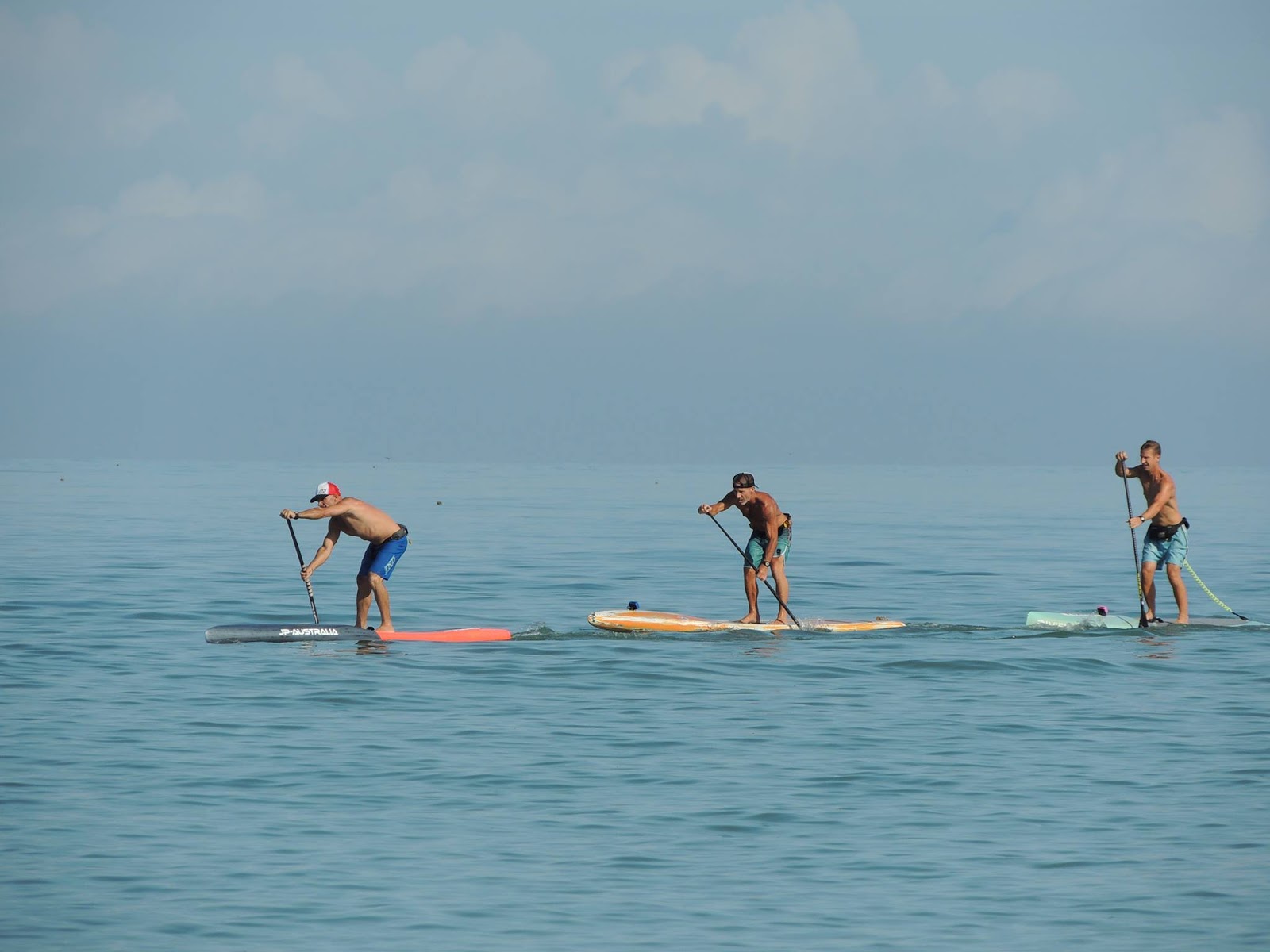
Draft train early in the race: Packet Casey, Mark Athanacio, me.


Race: The 9th Annual SUP Luau Race benefitting Collier County Special Olympics.

Date it happened: 6 May 2018

Location: In the Gulf of Mexico at Vanderbilt Beach, Naples, FL.

Distance: The competitive race was approximately 5.7 km. The course was four laps around a big rectangle that was pinched like a bow in the middle. After the competitive race there were shorter races for the Special Olympics athletes, and "family fun" races. My track from the race is below.


Conditions: The weather was warm and sunny with hardly any wind. There were some tiny swells and wakes on the Gulf, which could occasionally provide a little speed boost.

Participants and Gear: There was a good group of Special Olympians, with a lot of family members and volunteers supporting them and participating in the family fun races. For the competitive race we had a smaller group, but it included experienced studs Mark Athanacio, Packet Casey, Cindy Gibson, and Meg Bosi, among other race-savvy competitors from the CGT tribe. There were no divisions by board size, so most people used 14' boards if they had them. Some of the women on 14s included Meg Bosi, Damien Lin, and Donna Catron, while Cindy Gibson went with her trusty 12'6 Hovie Comet. Packet Casey used a JP Flatwater 14x25; 2" wider than the 14x23 JP that he used last year. I used my 14x23 Riviera RP, with an 18.5 cm Fins Unlimited seagrass fin that I now use for anything other than perfectly flat water.

Results: Since this was a low-key local race focused mostly on the recreational paddlers and Special Olympics athletes, I don't think they are going to post our times. They did keep track of who got what place, though. Packet Casey got first, I was second, and Mark Athanacio was third. Next was Mark Hourigan on a 14x25 Infinity Blackfish, followed by the amazing Cindy Gibson, who was the first place female. Cindy was a bit ahead of new dad Justin DiGiorgio, who was a bit ahead of Bill Mussenden. I think the 2nd and 3rd place women were Meg Bosi and Jen Hayes.

Play by play: I haven't been as obsessive about SUP training this year as in previous years, because my mind and my hours have been more occupied with work-related goals and struggles. I've still been getting time on the water, but not doing such intense intervals training as I was doing before, and not going to the gym. For the past month I've also been doing about half of my paddling on my new surfski kayak. So I wasn't sure how well I'd perform in this race. I knew that I'd be in the top three with Packet and Athanacio, but had no idea who among us would be in the lead.

After the running start from the beach, Packet was first to the first buoy, closely tailed by Athanacio, then me. Justin DiGiorgio also had a good start but dropped behind after the first buoy. The nearshore leg of the course was tricky because one of the buoys brought us into shallow water near shore. There was some strategy involved in deciding whether to take the most direct path to and from that buoy, or to try to stay in deeper (faster) water as long as possible. Following Athanacio and Packet I also played around with trying to ride various parts of their wakes, or getting in clean water and riding the micro-swells and swell-rebounds from the beach. The numerous buoy turns were another opportunity for skill and strategy. One could either step way back on the board to do a tight "pivot" turn, or one could try to just paddle a wider arc around the buoy. Athanacio has a quick pivot turn technique, and he got frustrated with me and Packet for doing slower turns. I reckon that polishing my buoy turns could gain me a board length or two each turn, which in a close race like this could end up making a big difference in final standings.

We did the first lap at a wicked pace around 9.6 kph (6 mph), and I was hurting in the second lap. Athanacio and I had dropped a few board lengths behind Packet, and I proposed that we work together to try to catch him. Athanacio let me around and I put in a good effort for a half lap, with the intention to yield back to Athanacio for the next half lap. But somehow I ended up losing Athanacio, and then I wasn't inclined to wait up for him so I just kept paddling, trying not drop too far behind Packet. That's how things stayed for the whole rest of the race. At times I got a little closer to Packet, but his buoy turns and accelerations were great, and he put on an extra effort in the last lap to get safely out of my reach by the finish.

Though I didn't win first place, I really enjoyed myself, and felt pleased with my pace and performance. My average speed was 9.3 kph, which is quite good for me, especially in a race with a lot of buoy turns. They gave out beautiful, handmade wooden trophies for 1st, 2nd, and 3rd place, and had a little podium set up for us to stand on. I was pleased to be up there with Packet and Athanacio. My trophy says, "Special Olympics - SUP Race - 2nd place," which is slightly embarrassing because I got my trophy without having to overcome the disabilities that the actual Special Olympics athletes face. Maybe next year they can have slightly different wording on the trophies for the non-special athletes, or just give us a little ribbon or something instead of a whole huge trophy.


After the competitive race was over, it was delightful to watch the Special Olympic athletes in their surprisingly fast and closely contested race. I stood in the water by one of the buoys and helped direct the athletes. The course instructions were a bit confusing for me, and I imagine more so for the athletes. Good on them for paddling as well as they did.

What's Next: Next race for me is next weekend in Edisto Island, near Charleston, South Carolina: it's the Edisto Island Classic 2018. It will be a heck of a long drive, but it's where my parents live, and I'll be staying in their beach house there for a few days of vacation.

Monday, April 30, 2018

Learning to paddle a "surfski" kayak

Lately my standup paddleboard racing buddies have been branching out into other forms of paddling. In our local club, the CGT Tribe, we now have about four new outrigger canoers, and three new surfski kayak paddlers. I am one of the new kayakers. These are the reasons I chose to try surfski kayaking:

1. I like to go fast. Racing kayaks are about 30% faster than SUPs, and generally faster than outrigger canoes, as well. Among paddle-powered craft, only rowing shells are faster than kayaks. But rowing shells have more rigging to fuss with, are more restricted to flat water, and force you to sit facing backwards, which seems unappealing. Also, nobody around here rows.

2. I like ocean paddling and "downwinding," which is what surfski kayaks are designed for. Surfskis are basically stretched-out versions of "sit on top" kayaks, which means they float like a surfboard and you don't have to worry about them sinking when you tip over and fall out. They do get some water splashed into the recessed "cockpit" area, but they have a one-way valve under your feet to drain that water out while you're paddling.

3. I had seen some exciting videos of expert surfski paddlers scooting down ocean swells, gliding from one peak to the next faster and with less effort than a SUP paddler would expend in the same conditions.

4. Most of the big SUP races in Florida also offer the option to race surfski or outrigger canoe. For really long races (>10 km) it would be nice to be on the faster craft that gets the race over earlier and easier. Also, being lower to the water makes sit-down paddlecraft easier to paddle upwind than standup paddleboards, and having a foot-pedal operated rudder lets them adjust for side-winds while still paddling symmetrically.

5. I ruled out outrigger canoe because the asymmetry of the outrigger on one side offends my slight OCD tendencies. That and the fact that OCs are supposedly not as fast as surfskis... Although I think that difference depends a lot on conditions and abilities. I.e., I think it's easier to adapt to rough water and downwinding on an OC than a surfski. That point is illustrated by my friends Justin and Matt, who got a surfski and an OC, respectively, around the same time. Justin is now easily faster than Matt in flat water, but Matt is faster and more comfortable in rough water and downwinders.

6. I heard that my buddy Murray, the most experienced kayaker in our group, was selling a very fast, advanced-level surfski for a ridiculously cheap price. Justin said that if I bought Murray's surfski, he'd give me his own older surfski paddle for free so I could get started right away. I suspected I'd never get such a cheap opportunity to try the sport again, since the boats are normally at least $3000. How could I refuse?

My surfski: The boat I bought from Murray is a 2009 model Epic V12. It's 640 cm (21') long by 43 cm (16.9") wide. The version I have is the second cheapest/heaviest construction offered, and it weighs around 15 kgs. The bottom is very rounded, which makes it extremely tippy for anyone not already skilled in paddling racing kayaks. If my boat choice weren't dictated primarily by what I could afford, I would have bought a much wider and more stable one, but I went into this with the full expectation that it would be very difficult.


The paddle I got from Justin was an Epic "wing" paddle, asymmetrically sculpted to effectively grab the water when swept out to the side of the board. Based on some online research I set up the paddle to have zero "offset angle" between the blades. The old wisdom was that the blades should be twisted 60 degrees so that while one was sweeping through the water, the other would knife through the air with minimal wind resistance. The new wisdom is that little is gained from that, and it just makes the stroke more complicated to learn. I've recently switched from the Epic paddle to a new Braca XI 705 paddle, because someone I lent the surfski to lost the Epic paddle and bought me the Braca to replace it. That was actually a boon for me, because the Braca is a fancier paddle. I have it set up with 0 offset, too.


My experience so far: My first surfski session, not counting the once or twice that I sat in Justin's beginner surfski, was 26 March 2018, in a bay with flat, shallow water. I got my butt in the seat of the Epic V12 and immediately capsized. I repeated this several more times until I was able to keep my butt in the seat, but only by straddling the kayak with my feet dangling in the water on each side. With my feet in the water it was just stable enough for me to tentatively begin paddling. For about 20 minutes I worked on getting my feet out of water and into the boat, but never managed more than a few frantic strokes with the feet in before capsizing. Finally my brain accepted the balance task I was asking of it, and I magically found myself able to keep the boat upright long enough to make substantial forward progress. I actually felt quite pleased with myself and ended up covering a lot of distance, even venturing out of the bay into the calm but slightly bumpy Gulf of Mexico. There I fell more often, and started to get tired. By the end of the session I was falling quite a bit again as both brain and body were worn out.

After the breakthrough on that initial session I expected to learn fast, but in fact my subsequent gains in stability have been more gradual. On my second session I was able to put my feet in the footstrap that covers the steering pedal area, as opposed to on top of the footstrap as I'd done initially. But I still fell a lot. Worse, I ended up with terrible bruises and sores in the area of my rear over my coccyx bone. I think it was from pushing with my legs and pressing myself into the back of the hard, bucket seat. After that session I went to a marine biology conference in Texas for three days, and it killed me to have to sit on my poor behind for hours watching presentations each day.

The first thing I did after Texas was duct tape some pieces of foam camping pad into the seat of the surfski to make it softer, copying a surfski seat pad design I'd seen online. I also added a little patch of pad on the under-knee area of the surfski, not to pad my legs but to pad my head because that's where I balance the boat on my head when walk it to the water. With my butt not in pain I was more comfortable in the boat, and started to be able to go faster. On my 6th session in the surfski I was finally able to go faster than my SUP speed. With new confidence I ventured to the Gulf of Mexico again, and was absolutely hopeless at staying in the boat.

Now after more than a month paddling the surfski, alternating with the SUP so I can rest my rear, I feel pretty comfortable in flat water. I'm able to concentrate more on the paddle stroke and its strange mechanics, which seems to be the key to tapping into the speed potential of the surfski. I have a long way to go with that, though. I'm still way behind Justin in speed even though I'm faster than him on SUP. In rough water I am still absolutely terrible, but not quite AS terrible as the first time I tried it. I've been able to get myself upwind enough to turn around and experience some of the exciting, downwind "bump riding" abilities of the surfski. My current efforts are on improving my stroke and speed in flat water, and improving my balance and upwind/downwind abilities in rough water. My goals for the time being are to able to hold a good 11+ kph pace in flat water, and to be able to get comfortable enough in rough water to try a downwinder with the other guys. I'll keep y'all posted.

Saturday, April 21, 2018

What am I resisting?

After work Thursday I came home and walked the dog. Then I loaded my formula windsurf board into the van and drove to the beach with the windows down. It’s a good life here in SW Florida in April. On the way to the beach a man in a black SUV burst my bubble by pulling up alongside me and asking in a confrontational tone, “What are you RESISTING?”

I gathered that he was referring to my “RESIST” bumper sticker. The sticker was designed by the progressive liberal organization Moveon.org to be an inspirational message to those discouraged by Trump and the GOP’s wins in 2016. To me, it’s a reminder to do whatever I can to resist attempts by those in power to weaken or degrade the things I value- Things like environmental protection, public education, race and gender equality, social services and infrastructure, etc. It would have been hard to explain all that by shouting through the window of a car to someone who didn’t want to listen. All I managed was, “The president- Trump!”

I’m sure my answer was no surprise to the man in the black SUV, but it gave him permission to shout his pro-Trump views. I listened and nodded and periodically gave a sarcastic “thumbs up” sign, but kept my eyes forward on the road and didn’t say anything else. I had no illusions that I might change the man, and I didn’t want to drive unsafely or escalate things into a road-rage situation. I don’t remember all of what he said, but I do remember that one of the first things was, “Trump is the greatest thing ever to happen to America!” And one of the last things he said was the ridiculous non-sequitur, “GET A JOB!” Eventually our paths diverged.

Although I am fairly good at keeping calm on the surface in an emotionally-charged conflict, such situations stir me up a lot on the inside. My thoughts race and my “fight or flight” hormones pump. I felt I’d handled this particular situation well by only minimally engaging, but afterwards I was stuck with some bad vibes that I’m working out of my mind now by writing this blog post. I hope to express to the universe some of the thoughts I was unable to articulate to the man on the road.

First, I would like to contest the man’s assertion that Trump is the greatest thing ever to happen to America. Below are some examples from American history of things I think I think were much greater than Trump’s election in 2016. In no particular order:

1. The 1st Amendment of 1791, which guarantees freedom of speech, freedom to protest, freedom of (and from) religion, etc. My RESIST bumper sticker is covered under the 1st Amendment.
2. The near-elimination of illiteracy by the investment in public schooling, starting around the time of the nation’s founding. "The whole people must take upon themselves the education of the whole people and be willing to bear the expenses of it. There should not be a district of one mile square, without a school in it, not founded by a charitable individual, but maintained at the public expense of the people themselves." — John Adams, U.S. President, 1785
3. The abolition of slavery in 1865, ending centuries of torture and inhumanity.
4. The development of public utilities including safe drinking water and indoor plumbing.
5. The anti-trust laws of the late 19th and early 20th centuries, which protected public interests from some of the worst abuses of power by big-business monopolies.
6. The spread of rapid travel and communication systems, connecting our country coast to coast and with the rest of the world.
7. The 19th Amendment in 1920, which finally gave women the right to vote.
8. The elimination of many diseases by the spreading science of vaccination and antibiotics in the early 20th century.
9. Various hard-won gains in workers’ rights, such as the fair labor standards act of 1938/1940, which limited the work week to 40 hours.
10. The sacrifices of hundreds of thousands who fought to free the world from fascist tyranny and genocide in World War II.
11. The development of effective and dependable police, fire-fighting, and medical first-response systems.
12. The Racketeer Influenced and Corrupt Organizations (RICO) Act of 1961, which greatly reduced the power of the Mafia and other criminal groups.
13. The triumphs of a non-violent civil rights movement over racial segregation in the mid 20th century.
14. The Clean Air Act of 1970 and the Clean Water Act of 1972, which protected Americans from the worst ills of rampant pollution.

Secondly, I would like to establish that I DO have a job. I worked hard to get my PhD and I continue to work hard seven days a week as a scientist and university professor, notwithstanding the occasional breaks for watersports and surfing the web. My primary motivation to work hard is not the avariciousness glorified by Trump. Rather, it’s a combination of scientific curiosity and a sense of duty to protect the ocean environment and educate the next generation.


PS- The formula windsurfing was great. The wind was a healthy 11-15 knots and I was well powered with my 9.5 Ezzy Cheetah sail. I had a good time buzzing around my buddies Cindy and Carlos who were doing a grueling paddleboard workout. For the first time I got some jibes on the formula board where I maintained the carve nicely and stayed fully-planing through the exit.

Thursday, April 5, 2018

Downwind Paddling, and Windsurfing a Downwind Paddleboard

Lately the CGT Tribe of standup paddleboarders, kayakers, and outrigger canoeists has been getting into a specialized paddling discipline called "downwinding." I've jumped on the bandwagon, too. This post is a brief introduction to downwinding, with a couple videos of our downwindwind sessions.

As one might imagine, paddling with the wind at your back is easier and faster than paddling into or perpendicular to the wind. This is especially true in standup paddleboarding, where your upright body catches a lot of wind. Thus, when it's windy, the idea of a downwind-only paddle outing, a "downwinder," is appealing.

The logistics for a downwinder are complicated, requiring either a non-paddling chauffeur, or multiple vehicles and carpooling exchanges.


You also need wind, and the wind must either be parallel to the shoreline, or the shoreline must be a curve subtended by a line from the upwind start to the downwind finish. The closer the path is to straight downwind, the better, but 10 or 20 degrees off is still OK. There is no strict wind minimum for a downwinder, but most people won't go unless it's windy enough to be whitecapping. 10 knots will do, 15 is good, and 20+ is excellent. Of course, those wind strengths are also great for windsurfing, which brings up the important question of, "Why paddle if you could sail?" My answer to this question is complicated, and still evolving.

Indeed, my first assessment of downwind paddling was that it was a third-rate alternative for people too stupid to windsurf or kiteboard. Why work much harder than a windsurfer, only to go to 1/3 the speed and be unable to return to where you started from?

I might have continued to dismiss downwind paddling if not for my back-door entry into the discipline via paddleboard racing. Since races were sometimes held in rough, windy waters, I started doing paddle workouts in the ocean on breezy days. I practiced paddling at all angles to the wind and chop, but of course enjoyed the downwind bits the most. I realized how engaging and rewarding it was to try to sync up with small, wind-driven waves, feeling the speed-boosting energy of each one. "Riding bumps," as they call it, offers some of the same challenge and gratifying feelings as the traditional mode of surfing waves breaking in shallow water. In windy conditions on open water, downwind paddling essentially becomes surfing, with the same dynamic of paddling hard to catch a ride, then gliding along effortlessly at thrilling speed. In a way, riding bumps downwind is better than surfing, because instead of having to turn around and paddle out again after each ride, you can keep your momentum going and link that first ride into another and another. On flat water, my fastest paddleboard speed for a mid-distance race is around 9 kph, but on a decent downwinder I can average over 11 kph, with peak speeds of 16-18 kph on the good bumps.

Another fun discovery with downwinding is that my "old beater" race paddleboard, a 2014 model Fanatic Falcon 14'x27.25", happens to be a rocketship for downwinding. Its bulbous nose combined with a narrow tail and rounded rails let it catch waves of all shapes, sizes, and angles with aplomb. The teardrop shape of the board also minimizes the amount of footwork you have to do keep the board trimmed properly in the waves- On other boards you're constantly stepping towards the nose to help catch the waves, then scooting back to the tail to keep the nose from plunging under as you surf down the waves. For example, my Riviera RP 14'x23" is a lot faster than the Fanatic in flat water, but is much trickier to use, and therefore slower, for downwinding. I haven't managed to take any "epic" GoPro videos of downwinders yet. The one time I wore my helmet camera for one was a grey day, and the wind sort of died in the middle of the run, but it was enough to get the idea.


Some better downwinder cinematography has been done by my avid downwind partners Greg from Belarus and Matt from Sarasota. Greg does most of his downwinders on a SIC Bullet (a specialized downwind board) or a Starboard AllStar (an all-around raceboard). For some of this video he was also trying out my Fanatic, which he said made everything incredibly easy.

DW-2-4-2018-NAPLES from New Ground Photography on Vimeo.


At the end of the run in Greg's video he let me try out a special contraption that I'd built to mount a windsurfing sail to his SIC Bullet. I'd been eager to do it since noting that the rocker and rail shape on the SIC Bullet was very much like an oversized windsurf board, and I suspected it would be fast and efficient under sail power. Indeed it was. This demonstration was also my not-so-sneaky way of trying to persuade Greg that windsurfing can be a lot of fun. For the next step, I'll loan him the adaptor plate and a small sail so he can mess around with it.

Windsurfing SIC Bullet from New Ground Photography on Vimeo.


My big challenge with downwinding now is keeping up with Matt from Sarasota, who has been doing the downwinders on his 20'8" Puakea outrigger canoe. With Matt's increasingly skilled piloting he has gotten average downwind speeds of 12.0 kph, which beats my best 11.8 kph on the same run with the Fanatic SUP. (This is our most common downwind run. It works in NW winds but requires a strenuous side-wind "traverse" to get offshore to the starting point.)


Is the need for downwind speed enough to tempt me into a sit-down paddlecraft myself? Stay tuned.

Tuesday, March 20, 2018

FL Keys Marine Lab field trip, Spring 2018

Every semester I take my FGCU Marine Ecology class to the Florida Keys Marine Laboratory for a few days of educational snorkeling. I bring lots of marine life guidebooks and encourage the students to identify all the organisms they see. I think learning what species you're looking at is the first step towards assessing the state of the ecosystem. It's also something I enjoy as a hobby, so I really look forward to photographically "collecting" new-to-me species.

This year I "scored" a few species that I was particularly excited about: Ocellate Box Crab, Batwing Coral Crab, Golfball Coral, Barred Hamlet, Reef Butterflyfish. You can find them and lots more, with descriptions, in the album of all the pictures I took this year, which is posted on my science facebook page.


The next part of this post may fall into the "too long didn't read" category for some people, but I felt like I should share these impressions about how the underwater habitats in the Florida Keys are doing lately, what with Hurricane Irma and some man-made problems, as well. Below is a summary of the changes I've seen at five of our regular snorkeling sites.

Site 1- KML Cove. The Keys Marine Lab is on the shallow, sheltered waters of Florida Bay. We do our first snorkeling activity in a little cove behind the lab. The cove has lush beds of seagrass and algae, with a few sponges and small, inconspicuous corals. I haven't noticed much change in the cove since Irma, besides some sunken branches and debris. However, there have been major impacts further north in Florida Bay, where lots of seagrasses died out due to salinity changes, murky water, and algae blooms. While boating through the Bay this spring we hit a line of the "post-Irma bad water," which was olive brown and totally opaque. Damage in Florida Bay can have a harmful domino effect, because when seagrass dies, it releases nutrients that cause algae blooms, which cause more seagrass to die, which releases more nutrients, and so on.

Site 2- Zane Grey Creek. This is a mangrove-lined, tidal channel that drains Long Key's shallow, internal lagoon. The creek waters can be tea-stained with tannins from seagrass and mangrove detritus, but they are generally fairly clear and high in salinity. Strong ebb-tide and flood-tide currents through the creek, coupled with its stable, high salinity, allow for the development of rich communities of filter-feeding organisms on the mangrove roots. In past years, sponges of all sorts- purple, blue, orange, white, brown, green, etc., covered the mangrove roots, and truck-tire sized loggerhead sponges studded the creek bottom. Those ALL died after Irma. Every single sponge. We speculate that they were done in by a combination of fresh water from the extreme rains, and the choking clouds of brown silt that were suspended in the water all around the keys in the weeks after Irma. I thought some sponges might recolonize the creek between November 2017 and March 2018, but they didn't. KML staff said that something similar happened in the creek after Hurricane Wilma in 2005, and it took about 7 years for the sponges to recover.

Site 3- Cheeca Rocks is a "patch reef" in shallow water relatively near the shore of Islamorada. It's designated as a Special Protected Area (SPA), which means that there's no fishing or collecting allowed there. It's unusual for a near-shore reef in that it still has a relatively high percentage of living hard corals, including the massive brain corals and star corals responsible for building the rocky structure of the reef. Since I first visited Cheeca Rocks in 2012 it has suffered from coral bleaching and disease outbreaks, which have killed or partially killed a substantial portion of the coral colonies. For example, some types of brain coral and maze coral are no longer present there. That said, Irma didn't seem to kill any corals at Cheeca Rocks that weren't already dead before the storm, although it did tip some colonies of star coral on their sides, and it moved sand that partially buried or un-buried portions of the reef. The main difference I noticed at Cheeca Rocks between November 2017 and March 2018 was a big increase in the amount of macroalgae (seaweed) on the reef. The algae and other soft-bodied organisms were probably blasted away by Irma's waves, but later took advantage of the vacant real-estate to recolonize. Algae compete with corals for light and space, so too much algae can harm reefs, especially if its growth is fueled by excess nutrients from pollution, or if the reef lacks algae-eaters like parrotfish and urchins.

Site 4- Alligator Reef. The saddest reef site, ironically, was the furthest offshore one that ought to be the most pristine and beautiful. Alligator Reef is a SPA like Cheeca Rocks, so it does have a lot of fish. It just has very little hard coral. Less than 1% of the sea bottom there is hard coral, whereas on a healthy reef it should be >30%. When I first visited Alligator Reef in 2012 there were at least a few colonies of hard coral studding the reef top. Those colonies included one endangered Elkhorn Coral, a remnant of the forest of Elkhorn Coral that covered most of Alligator Reef before it began dying off in the 1980s. Even though the reef was basically "dead" before Irma, inasmuch as it didn't have enough hard coral cover to keep its mineral growth rate apace with the rate of erosion, it at least looked pretty because there were lots of soft corals, sponges and algae on the reef skeleton. Irma swept those organisms away, highlighting the reef's depressing desolation. In November 2017 Alligator Reef just looked like a dusty concrete ledge. Since then the fast-growing algae have recolonized, and some of the soft corals and sponges are beginning to recover, as well. The hard corals really seem to be gone for good, though, which is crazy and awful.

Site 5- Stag Party. Staghorn Coral is a relative of Elkhorn Coral. It looks like deer antlers. It used to be one of the most common corals on Caribbean reefs, but it started dying out along with Elkhorn Coral in the 1980s. The "Stag Party" snorkel site was one of the few places where one could still reliably find Staghorn Coral in the 2000s, but bad bleaching and disease events in 2014, 2015, and 2016, related in part to mismanagement of water flow to the Everglades and Florida Bay, have almost completely wiped it out. I snorkeled the site for about 30 minutes this month before I found even one remnant patch of sick and pale looking Staghorn Coral. There have been big hopes that this potentially fast-growing coral will make a comeback, but I don't think it will happen unless we take big steps to fix our water pollution and climate change problems.

Sunday, February 11, 2018

RedBull Privateers Treasure Hunt SUP Race


Race: "RedBull Privateers"

Date it happened: 10 February 2018

Host: RedBull North America, in conjunction with the Rookery Bay Aquatic Preserve.

Location: This event was at an interestingly remote location, amidst an archipelago of uninhabited mangrove islands in the Rookery Bay Aquatic Preserve south of Marco Island, FL. To get to the staging area you needed to either boat or paddle 5 km from Marco Island. Many people voyaged to the staging area on Friday and camped overnight (it was quite a party, apparently) and some stayed again Saturday night. My team only went down for the day of the main event.

Course / Distance: This was not a normal race with a set course. Instead, it was a timed "treasure hunt" for teams of four paddlers. Fifteen treasure chests full of uniquely inscribed wooden coins were placed around the beaches and mangrove channels of the area, and the first team to collect all fifteen coins and bring their members over the line would win. The locations of the treasure chests were indicated on a map- actually a sticker that we could affix to our boards. But they purposefully didn't give us the map until 15 minutes before the race started so we couldn't plan and practice our routes ahead of time. Also, each treasure location was just marked with an "X." My team assigned numbers to each X to help track our collecting progress, but since the treasure chests themselves were not numbered, it was sometimes unclear if we were at the chest we thought we were at on the map. You could find a chest, but remain lost yourself. There was a 2.5 hour time limit for completing the course, and most teams split into two or more groups to try to reduce the distance that each member would need to travel in the allotted time.

Conditions: The weather was beautifully sunny and warm, with 5-15 knots of wind from the SE, making it a bit choppy in the open water areas. There was a strong tidal current flowing from E to W through Blind Pass and out of the channels draining the internal waterways of the island. Very shallow water in places was another hazard- it was important to find the deeper tidal channels when crossing the shallow internal bays of the island.

Participants and Gear: There were tons of people at the event. I'm not sure exactly how many, but I heard something like 50 teams of four, plus lots of supporters, spectators, and event staff. Compared to a typical SUP race there were more college-age and party-animal-age people there, but the over-the-hill crowd still represented well, and there were some families with kids. Some folks had come from Tampa or Miami / Ft. Lauderdale, and some from even further, like SIC Boards ambassador Robert Hess from South Carolina. At least one elite, international professional paddler was there: Hawaiian Josh Riccio (F-ONE boards). He was on a team with top Florida paddler Brad Ward (Sunova boards), Robert Hess, and another ripped dude whose name I don't know. Those guys looked like the clear favorites to win if it came down to simply who paddled fastest. If it came down to local knowledge, I thought the team of Collier County Special Olympics coaches led by experienced water explorer Steve Nagy and including CGT Tribeswoman Donna Catron would win. I thought my team had a good chance, too, with Beth Schadd and Saralane Harrer, who are some of the fastest women paddlers in the area, plus Saralane's husband Murray Hunkin who is an experienced South African kayak racers and a fierce SUP paddler. I used my 14x23 Riviera RP, Beth used my 14x27.25 Fanatic Falcon, Saralane used a 12'6x26 Riviera RP, and Murray used a 14x27 Starboard Allstar. Another tough-looking team had a mix of paddlers from the East and West coast of Florida- fitness model Karen Kennedy from the East coast and butt-kicking Cindy Gibson from the West. I also saw Neil Uden, the Australian husband of beautiful SUP starlet and environmental activist Catherine Uden, with a team of savvy East coast paddlers all wearing bright neon orange shirts. I think the team color coordination was a good strategy for locating teammates from far away on the water. Another color-coordinated team that I was surprised and delighted to see was made up of members of the Florida Gulf Coast University Fishing Team, including one of my undergraduate research students. They were all paddling unusual but fast L2Fish catamaran-style fishing SUPs. In addition to the tough looking teams, there were many teams in the event in which the competitors had never, or barely ever, paddleboarded before. They rented tubby beginner paddleboards provided by a Sarasota-based rental outfit, and they seemed to do OK.

Results: A team won (see picture), but it was neither my team nor any of the other teams I had pegged as likely winners. The winners got awesome trophies, money, and inflatable paddleboards. I'll update this post if I find the official results and prize list somewhere. Many teams, including mine, successfully collected all 15 coins, but had navigation and coordination difficulties of one sort or another that greatly delayed one or more of their members.


Play by play: There was some pre-story to this race. It started a month or two ago with me deciding I didn't want to do the race because the logistics sounded overly complicated. Then I changed my mind when Murray and Saralane asked if I could join their team. At the time, CGT shopowner Nick Paeno was going to be our fourth man. But then Murray and Saralane got cold feet about the logistics and our team disbanded. A little later, the team that Beth was on split up, but they had already paid, and Beth was able to sub-in other people; first Murray and Saralane and then me. The final re-formation of our team was only about a week before the race, but Beth helped get us organized with laminated aerial photo maps of the area, and a coordination meeting two nights before the race at Saralane's house. My initial doubts about the event were mostly replaced with excited anticipation. I liked that we had opted not to camp overnight- we would just make one (long) day of it.

The day started super early, when I loaded up the boards, picked up Beth, and drove to Marco Island. We got to Caxambas Park Marina and dropped our boards off at the registration area there. They wouldn't let us park at the boat launch, so we parked at Hilton Hotel and took a free shuttle from there. In addition to the shuttle from the hotel to the boat launch, there was a boat shuttle from the boat launch to the race site. I was leery of that for some reason, and anxious to start paddling and stop waiting around, so I decided to paddle to the race site (5 km). Beth took the boat and got there around the same time that I did, but my red Fanatic Board that she was going to use didn't show up for a long time because of confusion about where the drop-off place for boards for the boat shuttle was. Thankfully that was resolved before the race start by event staff calling back to the boat launch, locating, and loading the board.

My paddle to the event site was great. It had the feeling of leaving civilization (overdeveloped Marco Island) and heading into the wilds. I followed the western shore of the Cape Romano island complex south towards the event, admiring the blue water and the interesting birds along the sandbars and eroding mangrove shoreline. Aside from some distant boats, there wasn't another human in sight until I got near the tidal inlet called Blind Pass where the event was staged. First I saw a few campers' tents among the dead trees and sand-piles, then the whole event outpost came into view. People were swarming around a huge RedBull tent, and a giant inflatable Gorilla loomed over the SunBum sunscreen tent. Boards were splayed out everywhere. It got progressively more crowded each time the shuttle boat arrived, and a lot of people arrived by private boats, as well.

The shuttling took longer than the organizers had expected, so the race start was delayed from 11 until 1230. During the waiting time I socialized with folks and tried out some different boards, including Robert Hess' SIC RS 14x23, which seemed fast and light but tippy, as would be expected for such a narrow board. Finally the pre-race briefing began, and they revealed the treasure maps that we could put on our boards like bumper stickers. The background of the map was in a simplified style, but it was pretty clear how it corresponded with the laminated aerial photo maps we had printed. Since the treasure locations were only marked with Xs, I used a sharpie pen to number each of the treasures on my map and my teammates' maps. That way we knew who would be responsible for getting which treasures, and we had a common reference for which treasures were which, so we could refer to that in our walkie-talkie and cell phone communications during the race. We figured I was the fastest, so I would get the treasures that were farthest from the start and required paddling through the choppy and unprotected waters of the Gulf of Mexico. Saralane with her slower 12'6 board would get the treasures in Blind Pass near the starting area. Murray and Beth would split up the treasures inside Morgan's Bay. (That turned out to be the trickiest job, because of the confusing navigation there).


Once we had our plan, we hoped on the boards and gathered them inside a giant square on the water marked by four RedBull buoys. That corral formed a 360 degree starting line, from which we would radiate in various directions when a cannon blast sounded from a faux pirate ship parked offshore. I lined up on the southeast corner of the corral, which was the most upwind, upcurrent, and closest to my first treasure. When the horn blasted I sprinted off pretty well and headed closer to shore to get in the lee of the wind. I could see Josh Riccio zooming ahead in the same direction as me, but I knew I'd never catch him, so I just tried to go my fastest normal pace. I was abreast of Robert Hess, who was going about the same speed as me. To save energy I crossed into his draft. That was highly effective, because as a big broad shouldered guy he was blocking the wind well and digging a deep furrow through the ocean that pulled my board along. As we went I counted the tidal inlets that we passed, knowing my first treasure to get would be around the third one. It was easy to find those first treasure chests, because I just watched where Josh Riccio went ashore, and followed that route. I had to leave Robert's draft to get the coins, but he soon went in a different direction, anyway, so it didn't really matter. I think I spent longer than necessary undoing my leash and removing my camelback to stuff the coin in each time I came ashore- I'll have to work out a more efficient coin pouch system if I do this next year.

The most distant coin I had to pick up was at a beach near the famous "Dome Homes" at the southern tip of Cape Romano. My next move after that was to paddle into Morgan's Bay and get a coin from a straight, manmade channel. As I approached it I saw a big guy on a Starboard Allstar emerging from it - MURRAY! He gestured that he'd gotten the coin so I didn't need to go down there. Instead I chased him down and offered to help him with whatever coin collecting he was still doing. As I tagged along with him I ran into Beth and decided to go with her, since it looked like Murray was about to finish and Beth might need more help. Some other racers were also milling about that area confusedly, including (to my relief) Brad Ward and Robert Hess. Beth seemed to know where she was going, and we got another coin as we left the bay and entered the Gulf. There was one last coin that Beth needed, and we saw the flag for that one from the entrance to a shallow bay. I said I'd get it, and sent Beth back to the start line to make sure we all got back there as quick as possible. I weaved through the slightly deeper parts of that shallow bay, got the coin as quick as possible, and made haste for the start-finish line. Saralane and Beth were already there, with their coins. No other teams had finished yet. We could win it! We just needed Murray.

It was determined that I would paddle East in Blind Pass to try to intercept Murray on his return, to provide encouragement and a draft. Unfortunately, I paddled and paddled and never saw Murray. Then the ladies radioed me and said the race was over- still no Murray. Doh! I paddled back, and Murray actually beat me there, having returned via the Gulf because he'd never found the back way to Blind Pass that he'd intended to return on. Here's my GPS track from the race:


Our team successfully collected all 15 treasure coins, which we felt was a pretty good achievement despite our troubles and getting lost. Apparently Murray's long period of being lost was in search of a coin he didn't realize he'd already collected. It was really tough to know where you were, even when you were at a treasure, because the treasures didn't have any unique labeling system that corresponded with the map. I would suggest to the event organizers to put numbers on the treasure chests corresponding with numbers on the map, so when you found a treasure you would know for sure where you were on the map.

After the race there was a pig roast, awards, and raffle, but we didn't stick around for that because we wanted to make sure we escaped the island before dark. I did buy a cheeseburger from the Food Boat, though, which tasted pretty good after paddling 20 kilometers that day. Then Beth and I loaded up the boards and we both paddled back to the boat launch, thankfully with a tailwind making it easy. Overall it was a great day, and I definitely see the fun and appeal of an event like this. Some ideas I have to do better at the next one are:

1. Do a preliminary trip to the site to paddle around and get the feel for what it looks like on the water, since studying Google Earth alone doesn't quite cut it.
2. Plan more mid-race "check ins" with teammates by phone, radio, or (best of all) meeting up where our paths intersect on the water.
3. Make sure we don't waste time getting coins that have already been gotten, or that another teammate will soon be getting.
4. Not go looking for lost teammates if there's a possibility they might be about to return.
Sunday, February 4, 2018

Race Report: Paddle at the Pass 2018


Race: "Paddle at the Pass"

Date it happened: 4 February 2018

Host: The South Florida Canoe and Kayak Club, which "is a 501 (c) (3) non-profit member based organization in Cape Coral, Florida offering both development and high performance training in flatwater sprint canoe and kayak racing, stand up paddleboard racing, surf ski, dragonboat racing and para canoe. SFCKC has world class coaches with experience in National, International and Olympic level regattas. We are also proud to be the home of two Olympic hopeful athletes training daily with our club."

Location: Matlacha Community Park, on the cute, island community of Matlacha, which lies in the "Matlacha Pass" estuary between Cape Coral and Pine Island. I was familiar with the area because it was the launch site for a seagrass survey project I did for Lee County in summer of 2014. The waters of Matlacha Pass are shallow and have historically supported extensive seagrass beds and oyster reefs. However, the water quality and habitats have declined in recent years due to nutrient pollution from the growing Lee County population, combined with damaging freshwater discharges from Lake Okeechobee via the Caloosahatchee River at the south end of the pass. (An interesting tidbit of geological history is that Matlacha Pass was once the channel of the Caloosahatchee River, which flowed north into Charlotte Harbor, before sea level rose and the river found a more southerly outlet through San Carlos Bay.)


Course / Distance: There was a 5km course for the under-14 and under-18 year old racers, and a 10 km course for the adults. The courses were originally intended to be one and two circumnavigations, respectively, of Matlacha Island. However, a very low tide combined with the water-pushing-out-effect of several days of East winds had exposed impassable shallows along that route. The race committee adapted well to the new situation by setting out-and-back courses running along a the main channel of the estuary. (See my GPS track from the race; I measured the distance paddled as 10.28 km)


Conditions: There was 8-15 knots of wind from the ENE, which was side-wind for the entire course, but more downwind on the first part and more upwind on the return. The wind increased from the 930 am race start until the end, so the slower paddlers had to fight the worst of it. Shallow water, knee- to waist-deep for much of the course, with exposed oyster reefs, sandbars, and blue crab traps in places, also slowed things down and made it important to stay in the relatively deeper spots. There was some current from the outgoing tide that was most notable at the south end of the course. It helped us in the first half and slowed us coming back.

Participants, Results and Gear: There was a good turnout of fast kayakers from the SFCKC youth development program, along with some adult kayakers. Some, like my friend Justin DiGiorgio, were in surfski kayaks (the sit-on-top racing kayaks that can tip over without filling up with water). Others were in K1 kayaks (the kind that are hollow and your legs go inside). The fastest K1 kayaker was elite athlete Fabio Wyss, who recently represented Switzerland in the K1 1000 meter event in the 2016 Rio Olympics. Like a lot of international paddle athletes from cold countries, he trains in Florida in the winter. One of the SFCKC youths was in a C1 racing canoe, which requires an awkward, asymmetrical kneeling stance, and super good balance because it's pencil thin but has no outrigger for stability. Mark Athanacio used his V1 rudderless outrigger canoe and was the only outrigger canoe paddler at this race. I was on my trusty 14'x23" Riviera race SUP, and my toughest SUP competitor was Greg Zasinets on a 14'x24.5" Starboard Allstar. Carlos Colon and Bryan Herrick also raced 14' sups, and Cindy Gibson, Donna Catron, and Jen Hayes raced 12'6 sups.

I don't have the full results list, but I know Fabio was the first, finishing the 10.28 km in 52:48 on his K1 kayak. He said his pace was a lot slower than normal because of the shallow water and wind. Justin DiGiorgio held his own with the more experienced kayakers and finished in 1:07:30, a little ahead of Mark Athanacio's outrigger. I was the first SUP in 1:15:04. The official time may be about 2 minutes slower than that, since they started the SUPs after the kayaks but didn't account for that in the time-elapsed calculations. Greg Zasinets was about 2 minutes behind me. Cindy and Carlos were the next sup finishers in around 1:27:00, with Cindy blasting over the line just ahead of Carlos- an impressive feat with her being on a slower 12'6 board. Donna and Jen caught the worst of the wind but managed to battle over the line in less than 2 hours.

Play by play: The sit-down craft started first, and the SUPs started about 2 minutes later. I started at the upwind end of the line and angled slightly upwind for the first bit of the race, to build kind of a "high ground" on my competitors. After the starting sprint I took a look around and saw that I was securely ahead of everybody except Greg Zasinets, who was dead even with me but further downwind. I then started to strategically "spend" my upwind position to put on little bursts of speed when the side-chop presented an opportunity to ride a "micro-bump." That strategy worked OK, and I had maybe 50 or 100 meters on Greg as we neared the halfway point. Approaching that turn-around buoy was the fastest section of the course, with a tidal current helping, and the wind more at our backs. My buoy turn at the halfway point was OK- I didn't fall, at least. But I got a fright to see Greg much too close for comfort with the toughest half of the race still ahead. Going north, fighting the sidewind/upwind and only being able to paddle on the left, was a major drag. My lower back and hips felt the burn from the twisting motion of paddling. It helped to focus on individual landmarks and choosing the optimal path to travel to distract from the physical unpleasantness. Sometimes I counted strokes to keep from falling into a slower rhythm. It wasn't clear whether Greg was gaining on me or falling behind until about 3/4 of the way through the race where it finally seemed like I had extended my lead somewhat. That last section of the race was side-wind hell, and it took every trick in the book to keep my board pointed where I wanted it to go and moving at a reasonable pace. Finally, it was over. Woo hoo!

I watched Greg finish, then packed the van and came back out on the observation pier to watch other finishers. While I was packing up I missed the big battle between Cindy and Carlos, so I only heard about that secondhand. Incredibly, after the race Cindy stayed on her board near the finish line and started practicing upwind/downwind runs in the strengthening wind. She is one tough lady.

Even though this was a small race, they gave out medals. Almost everybody got a medal because of all the different age and board classes, and all the medalists got their picture taken with Fabio. (U14, U18, 18-29, 30-39, 40-49, 50+) I'm OK with that. You have to be in it to win it, right? If you're the only 40-49 year old who shows up and suffers through a long windy race on a SUP, then I reckon you deserve that gold medal and picture with Fabio.

After the race some of us had lunch at the Blue Dog cafe next to the race site. It was awesome. This whole weekend has been awesome, actually, because today I got to do a sunny "downwinder" paddle with a lot of the same crew who were at the race, and I even did some windsurfing after that. Hooray for February in Florida!